
Short Drill Point Die Life? Check These 4 Areas Before Changing Die Material
Drill point die life suddenly shorter? Compare machine condition, die alignment, screw wire and production setup before changing die material or die supplier.
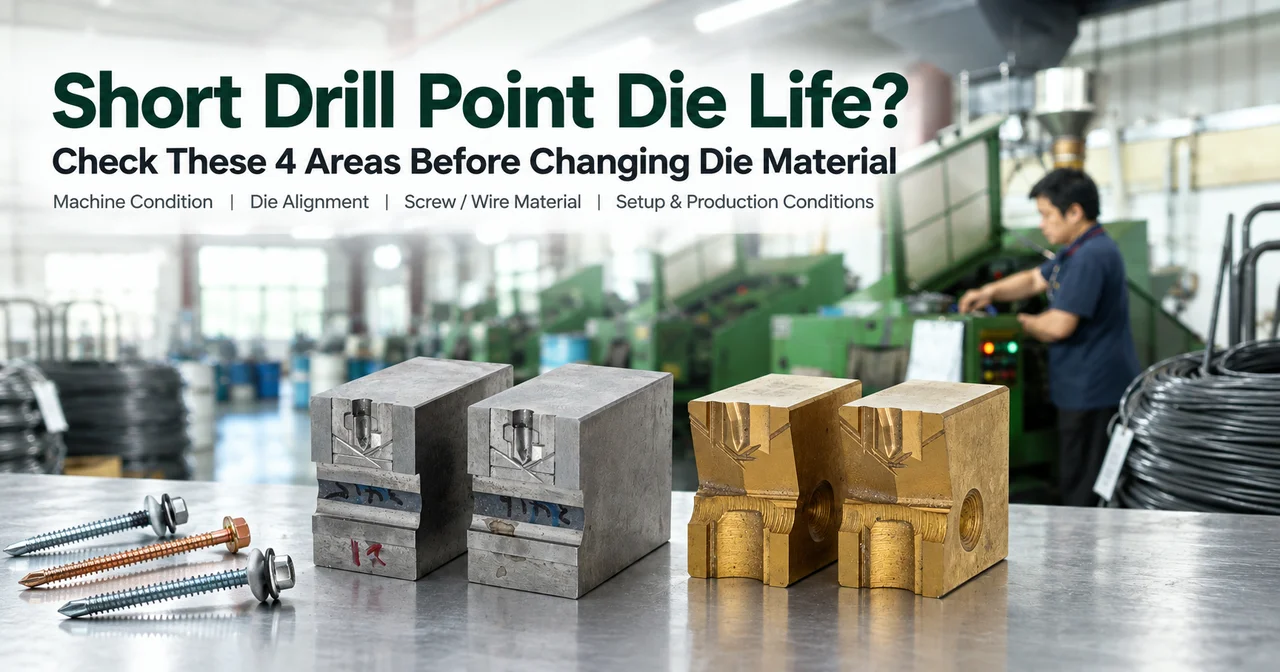
When a drill point die wears out much earlier than expected, the first reaction is often:
"Should we change the die material?"
Or:
"Is this a die quality problem?"
Sometimes the answer is yes. But not always.
Short drill point die life can also be related to machine condition, die alignment, screw wire, lubrication, installation, or other production conditions. Even a good die can perform very differently when one of these variables changes.
Before changing from HSS to tungsten carbide — or changing your die supplier — check these four areas first.
Quick Answer
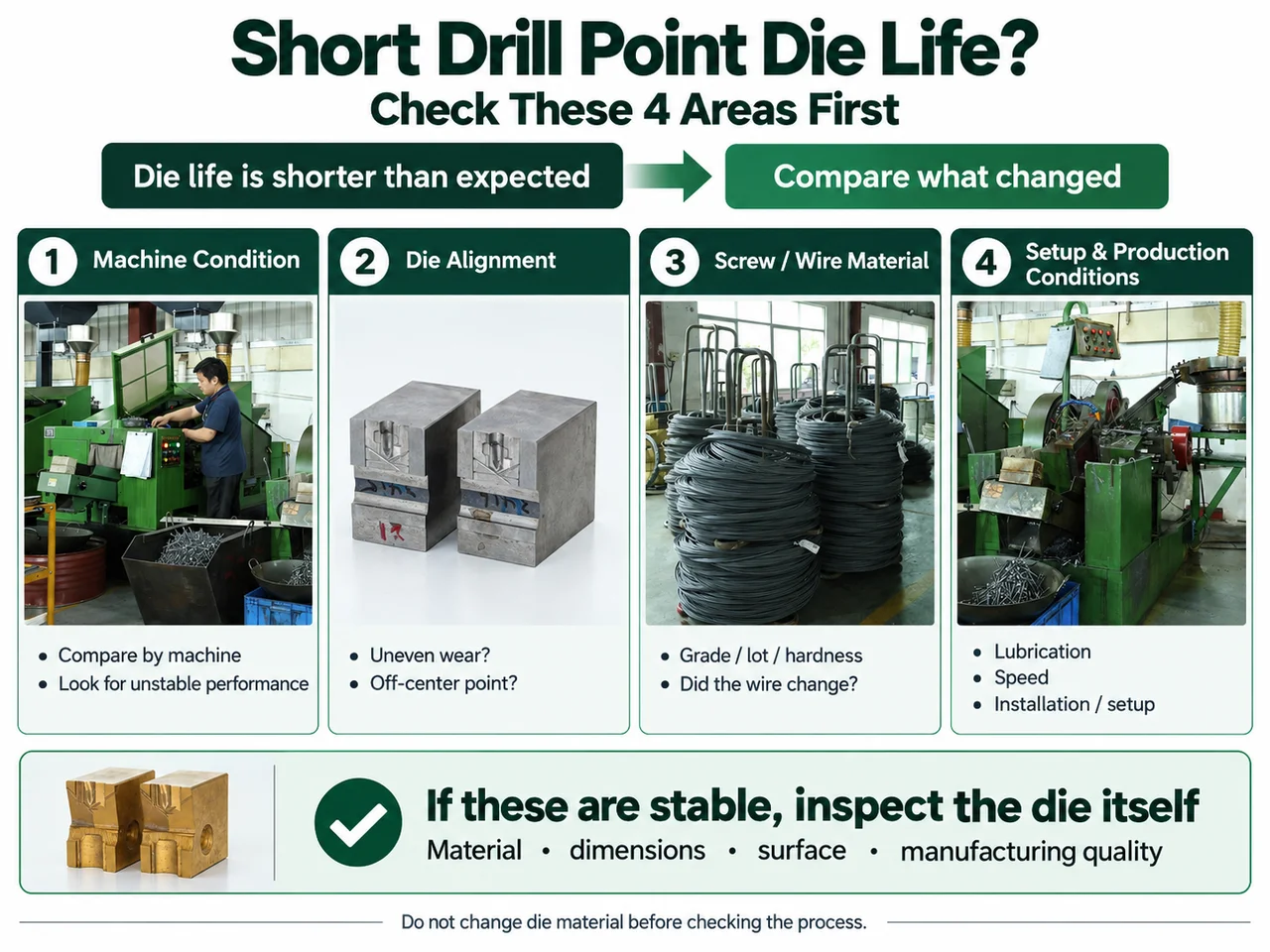
If drill point die life suddenly becomes shorter, check:
| Area | What to Compare First |
|---|---|
| 1. Machine Condition | Does the same die perform differently on different machines? |
| 2. Die Alignment | Is wear uneven? Is the drill point off-center? |
| 3. Screw / Wire Material | Did the problem begin after a wire grade, supplier, or lot change? |
| 4. Setup & Production Conditions | Did lubrication, speed, installation, or other settings change? |
If these four areas remain stable but several new dies still show abnormal or consistently short life, then the die itself — its material, dimensions, surface condition, or manufacturing quality — should be investigated further.
The goal is simple:
Do not replace the die before you understand what is shortening its life.
1. Check the Machine Condition
One of the fastest ways to narrow down a die-life problem is to compare performance across machines.
Ask:
Does the same die type consistently last longer on one machine than another?
If dies from the same batch perform normally on Machine A but repeatedly wear or fail early on Machine B, the machine becomes an important part of the diagnosis.
Machine-related factors can include worn guide components, die holders, vibration, inconsistent movement, or other mechanical conditions affecting how the die contacts the screw blank.
What to Look For
Compare:
- Die life on different machines
- Failure location on different die pairs
- Recent machine maintenance or component replacement
- Whether screw quality changes after moving production to another machine
Do not rely on a single failed die.
Look for a pattern.
If one machine repeatedly produces shorter die life, investigate the machine before concluding that every die is defective. Tracking die performance by machine is already one of the most useful ways to separate tooling problems from production problems.
2. Check Die Alignment
Alignment problems often leave visible evidence.
When the two die halves do not work evenly around the screw blank, the load may not be distributed evenly. This can contribute to localized wear, chipping, off-center drill points, or inconsistent flute geometry.
Warning Signs
Look more closely at alignment if you see:
- One die half wearing faster than the other
- Chipping repeatedly appearing in the same location
- One side of the drill point looking different from the other
- The finished drill point moving away from the screw centerline
Uniform wear over a long production run and strongly localized wear are not the same failure pattern.
Localized wear deserves additional investigation.
What to Check
Check whether:
- Both die halves are seated correctly
- The holder condition is stable
- Guide components show visible wear
- The screw blank enters the forming position consistently
- The same abnormal wear pattern appears on several replacement dies
If a new die repeatedly develops damage in approximately the same area, simply installing another die may reproduce the same failure.
Chipping, off-center points and galling are covered failure by failure in our drill point die troubleshooting guide.
3. Check the Screw / Wire Material
A die does not work independently from the material it is forming.
Changes in wire condition can change forming resistance and therefore affect both drill point quality and die performance.
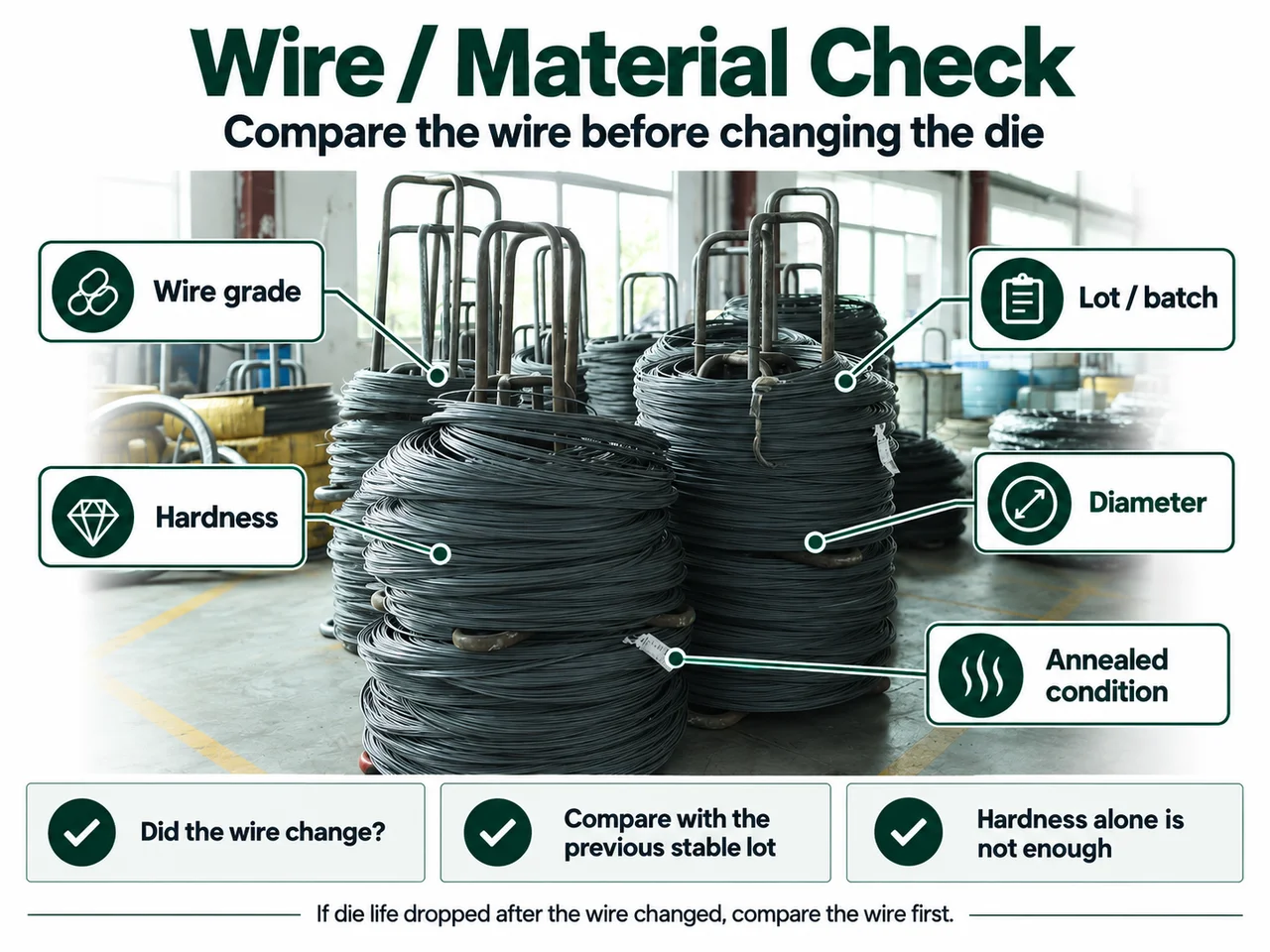
Important variables can include:
- Wire grade
- Annealed condition
- Hardness
- Tensile properties
- Wire diameter
- Spheroidization
- Differences between wire lots
Wire that is harder or more difficult to form generally increases the load on the forming process. At the same time, hardness alone does not explain everything: annealing condition, spheroidization, lubrication, machine condition, speed, and die setup work together. Two wire lots that both meet an acceptance range can still behave differently during point forming.
A Useful Question to Ask
Did die life drop after the wire changed?
If your die was previously running normally and the problem appeared after:
- Changing wire supplier
- Changing material grade
- Starting a new wire lot
- Changing annealing condition
- Receiving wire with noticeably different forming behavior
compare the wire information before changing the die material.
This does not automatically mean the wire is defective.
It means the wire is a variable that should be included in the diagnosis.
For the properties wire mills actually report — annealed and non-annealed hardness, tensile strength, decarburization and spheroidization — see our fastener wire mechanical properties reference.
Do Not Record Only the Screw Size
"#10 self-drilling screw" is not enough information to explain a die-life problem.
Where possible, also record the material grade, wire condition, diameter, batch information, and any available mechanical-property data.
That information helps both the screw manufacturer and the die supplier make a better judgement.
4. Check Setup & Production Conditions
Sometimes neither the die nor the wire has changed — but the way the production line is running has.
Before blaming the die, ask:
What changed around the time die life became shorter?
Several production variables deserve attention.
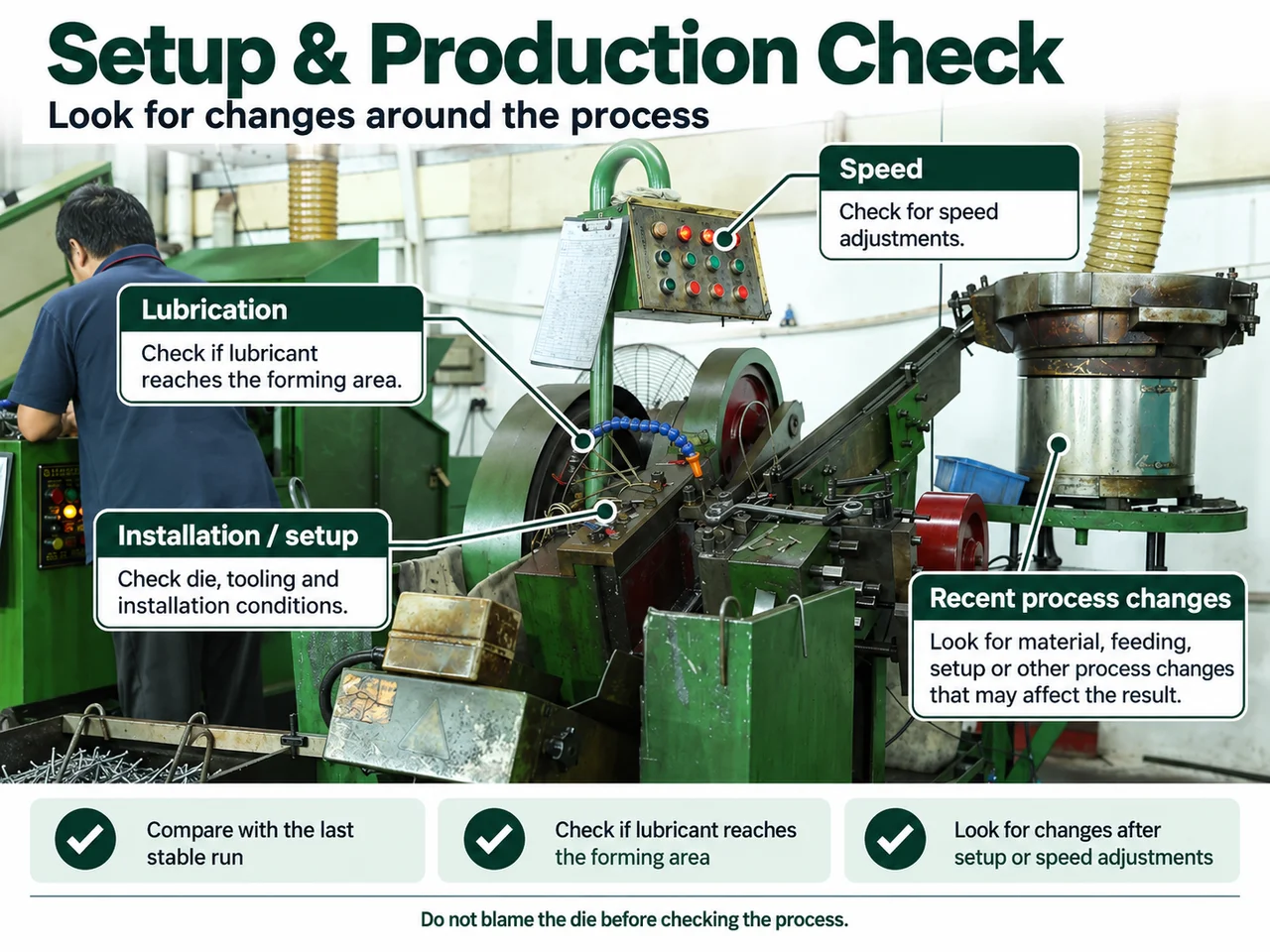
Lubrication
Lubrication helps reduce friction and metal-to-metal contact during forming. Inadequate or inconsistent lubrication can contribute to higher friction, surface wear, heat, or material adhesion on the die surface.
Check:
- Whether lubricant reaches both die halves consistently
- Whether a nozzle is blocked or incorrectly positioned
- Whether the lubricant type or condition has changed
- Whether material is beginning to build up on the die surface
Machine Speed and Production Rate
Higher production speed can change impact, heat generation, vibration, and lubrication conditions.
If die life changed after production speed was increased, compare performance at the previous stable setting before drawing conclusions about the die.
There is no single speed adjustment that is correct for every screw size, die material, machine, and wire condition.
Use your previously stable production condition as the first comparison point.
Installation and Setup
A good die can still fail early if it is installed incorrectly.
Check whether:
- The die is seated correctly in the holder
- The two halves are installed consistently
- The setup changed between shifts
- The problem appeared immediately after a die change or machine adjustment
The useful question is not simply:
"What is the correct setting?"
It is:
"What changed from the last stable production run?"
That comparison is often more useful during troubleshooting.
5. When Should You Suspect the Die Itself?
Not every short-life problem comes from the production line.
The die itself should also be investigated when the evidence points in that direction.
Possible die-related factors include material condition, hardness, dimensions, surface finish, internal defects, or manufacturing accuracy.
You should investigate the die more closely when:
- Several new die pairs show the same abnormal failure under previously stable production conditions
- The same problem follows the die when it is tested under another known-stable setup
- Incoming inspection finds dimensional or visible surface abnormalities
- The machine, alignment, wire, lubrication, and setup have been checked but the abnormal life remains repeatable
The important word is repeatable.
One failed die can provide a clue.
A repeated failure pattern provides much stronger evidence.
This is why troubleshooting should compare conditions instead of immediately assigning responsibility to either the die supplier or the screw manufacturer.
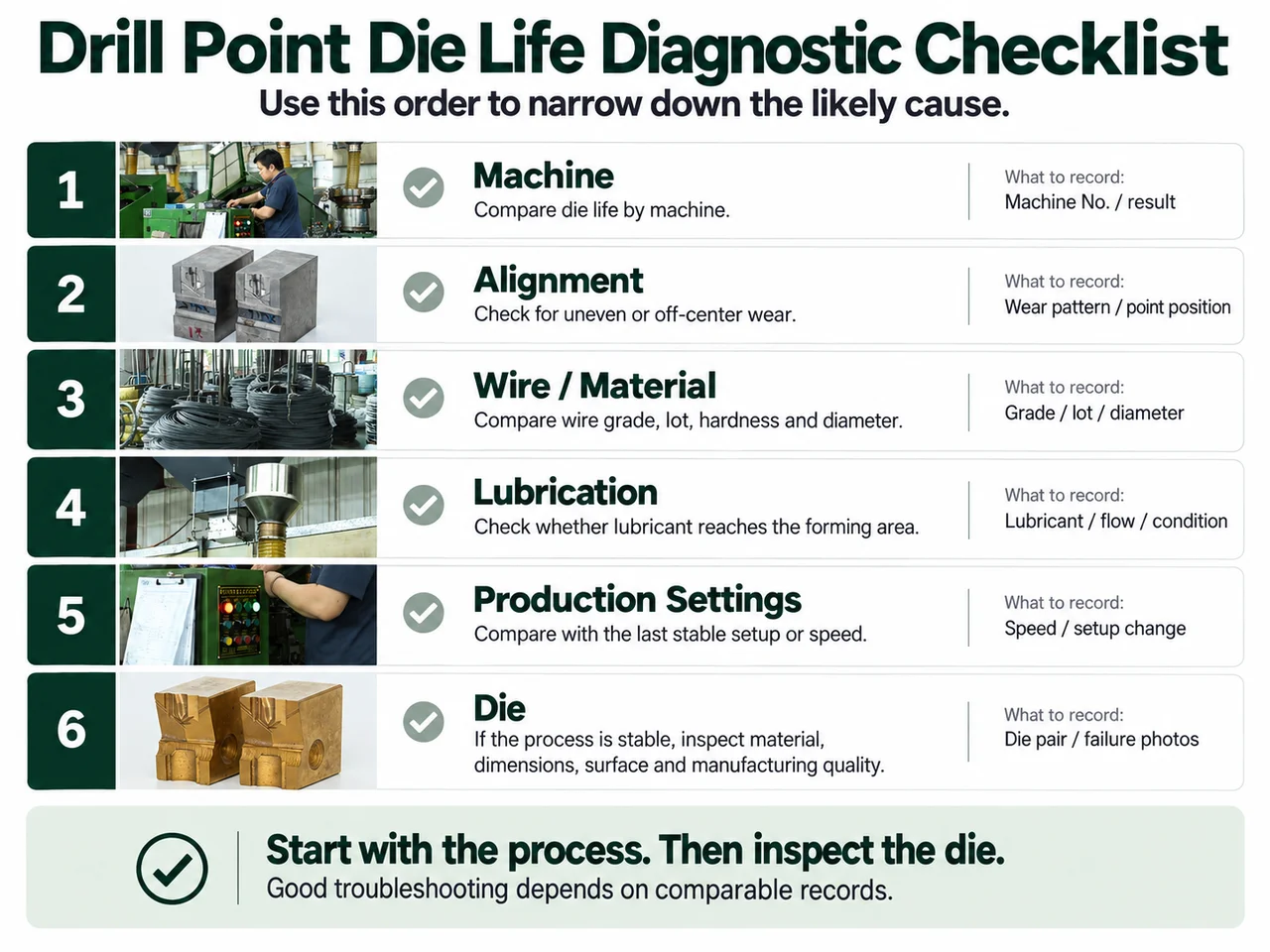
6. Use a Simple Drill Point Die Life Diagnostic Checklist
When die life becomes abnormal, work through the problem in order.
| Check | Question | What the Result May Tell You |
|---|---|---|
| Machine | Does the same die perform differently on another machine? | Machine condition may be contributing |
| Alignment | Is wear localized or strongly uneven? | Check die seating, holders and alignment |
| Wire | Did material, supplier or wire lot change? | Compare wire condition and forming behavior |
| Lubrication | Is lubricant reaching the forming area consistently? | Friction or galling may be increasing |
| Production Settings | Did speed or setup change? | Compare with the previous stable condition |
| Die | Does the failure remain after the other variables are controlled? | Investigate die material, dimensions and manufacturing quality |
This checklist is not intended to identify every possible failure mode.
Its purpose is to prevent one common troubleshooting mistake:
Changing the die before checking the production conditions around it.
7. Track Die Life by Pieces Produced — Not Just by Days
"Lasted three days" is not a very useful die-life record.
Three days on one line may represent a very different production quantity from three days on another.
A better record includes:
| Data to Record | Example |
|---|---|
| Die Pair / Batch | Internal tracking number |
| Die Material | HSS / tungsten carbide |
| Screw Specification | Size + drill point specification |
| Wire Material / Lot | Grade + lot information |
| Machine | Machine number |
| Production Quantity | Pieces produced |
| Failure Mode | Normal wear / chipping / galling / other |
| Failure Position | Uniform / localized / one side |
| Recent Process Change | Wire / speed / lubrication / setup |
Over time, this data helps answer much better questions:
- Does one machine consistently shorten die life?
- Does a particular wire lot change performance?
- Does the same failure location appear on multiple dies?
- Is the die actually wearing normally, but production volume has increased?
Good troubleshooting starts with comparable data.
8. What Should You Send a Die Supplier for Diagnosis?
If you cannot identify the cause internally, do not send only one sentence:
"Your die life is too short."
That gives the supplier very little information to work with.
For a more useful first diagnosis, send:
- Screw specification — size, drill point type, drawing or finished screw sample if available.
- Screw / wire material information — material grade, wire diameter, hardness or other available wire data.
- Current die life — approximate number of screws produced per die pair, not only production days.
- Failure photos — clear photos of both die halves and the drill points produced before and after the problem appeared.
- Production information — machine type or machine number, relevant setup information, and any recent changes in wire, lubrication, speed or installation.
With these details, a die supplier can make a much more useful first judgement about whether the problem is more likely related to the die, machine, alignment, wire, or production setup.
That is far more useful than immediately recommending a different die material.
Which one for your line?
Send your screw size, wire material and current die life — we'll give you a judgement based on your actual production.
Ask our engineersBefore You Replace the Die, Find the Pattern
Short die life is not a diagnosis.
It is a symptom.
The fastest way to get closer to the root cause is to compare what changed:
Machine. Alignment. Wire. Production conditions.
Then evaluate the die itself.
If the process is stable and you are genuinely comparing tooling options, see our HSS vs tungsten carbide selection framework and the drill point die material selection guide for carbide grades, cobalt content and coating options.
If you are experiencing unusually short drill point die life, send us your screw specification, wire/material information, current die life, failure photos, and production conditions. ZLD Precision Mold can help review the failure pattern first and determine what should be checked next.
Standard samples: 3–4 days Trial orders: from 1 set
Send your production details — or use the WhatsApp button on this page if you prefer to send photos and drawings directly.
Frequently Asked Questions
Does short drill point die life always mean poor die quality?
No. Die quality can be one cause, but machine condition, alignment, wire properties, lubrication, installation and production settings can also affect die life. The best approach is to compare the conditions and the failure pattern before deciding where the problem comes from.
Should I switch from HSS to tungsten carbide when die life is short?
Not automatically. Tungsten carbide is commonly preferred for stable, higher-volume production because of its wear resistance, while HSS still has practical applications. But if abnormal die life is caused by misalignment, difficult wire conditions, poor lubrication or an unstable machine setup, changing material alone may not solve the root problem. Check the production conditions first.
Can wire hardness affect drill point die life?
Yes, wire condition can affect forming resistance and die load. However, hardness should not be considered alone. Material grade, annealed condition, spheroidization, diameter, lubrication, machine condition and setup can all influence how the wire behaves during forming.
What information is most useful when diagnosing short die life?
Start with the screw specification, wire information, production quantity per die pair, photos of the failed die and the finished drill point, machine information, and any recent changes in production conditions. The more accurately the conditions can be compared, the easier it is to narrow down the likely cause.