
HSS vs Tungsten Carbide Drill Point Dies: Which Should You Choose?
The choice is not about which material lasts longer. It depends on whether your screw specification is stable, how long each run is, and what your tooling cost per screw actually is — a practical selection framework for self-drilling screw manufacturers.
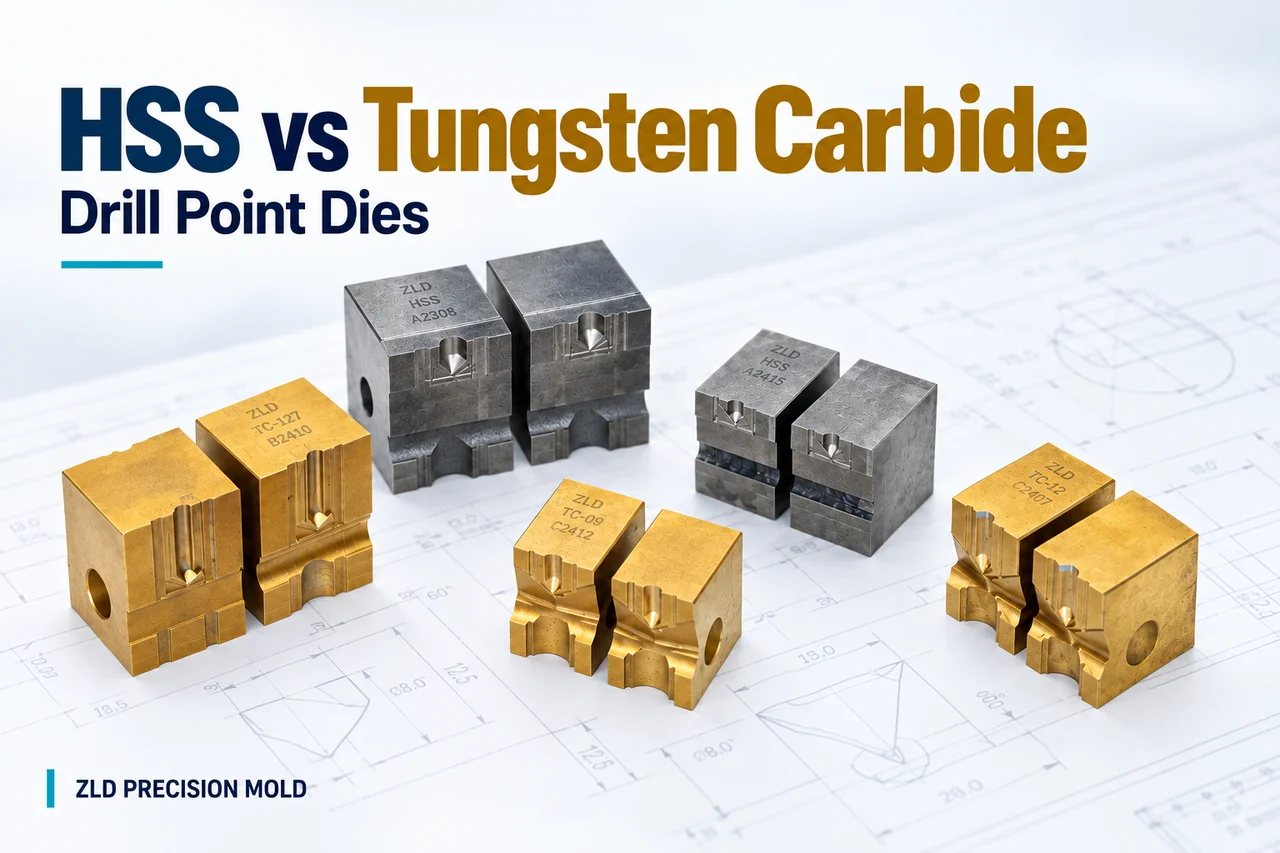
Choosing between HSS and tungsten carbide drill point dies is not simply a question of which material lasts longer.
For self-drilling screw manufacturers, the better choice depends on the actual production situation:
- Is the screw size still being tested?
- Are specifications changing frequently?
- Is the product made in short runs or continuous production?
- What wire or screw blank material are you forming?
- How often are dies being replaced?
- Is current die life stable and predictable?
HSS and tungsten carbide are often suitable for different production conditions. The better question is:
Which material gives better tooling economics for your production?
Quick Answer: HSS or Tungsten Carbide?
| Production Situation | HSS | Tungsten Carbide |
|---|---|---|
| Trial production | Often practical | Usually considered after validation |
| New screw sizes | Often practical | Depends on production plan |
| Small batches | Often practical | Depends on required die life |
| Frequent specification changes | Often practical | Depends |
| Short production runs | Often practical | Depends |
| Stable specifications | Suitable | Often preferred |
| Long-running production | Suitable | Often preferred |
| High-volume production | Suitable | Often preferred |
| Frequent die changes | Depends on actual cause | Worth evaluating |
| Higher tool-life requirement | Depends on process | Worth evaluating |
This does not mean HSS is only for low-volume production, or that tungsten carbide is automatically the correct choice for every high-volume line. Production volume is only one factor.
Wire or screw blank material, machine condition, die alignment, production setup and actual die life can all affect the final recommendation.
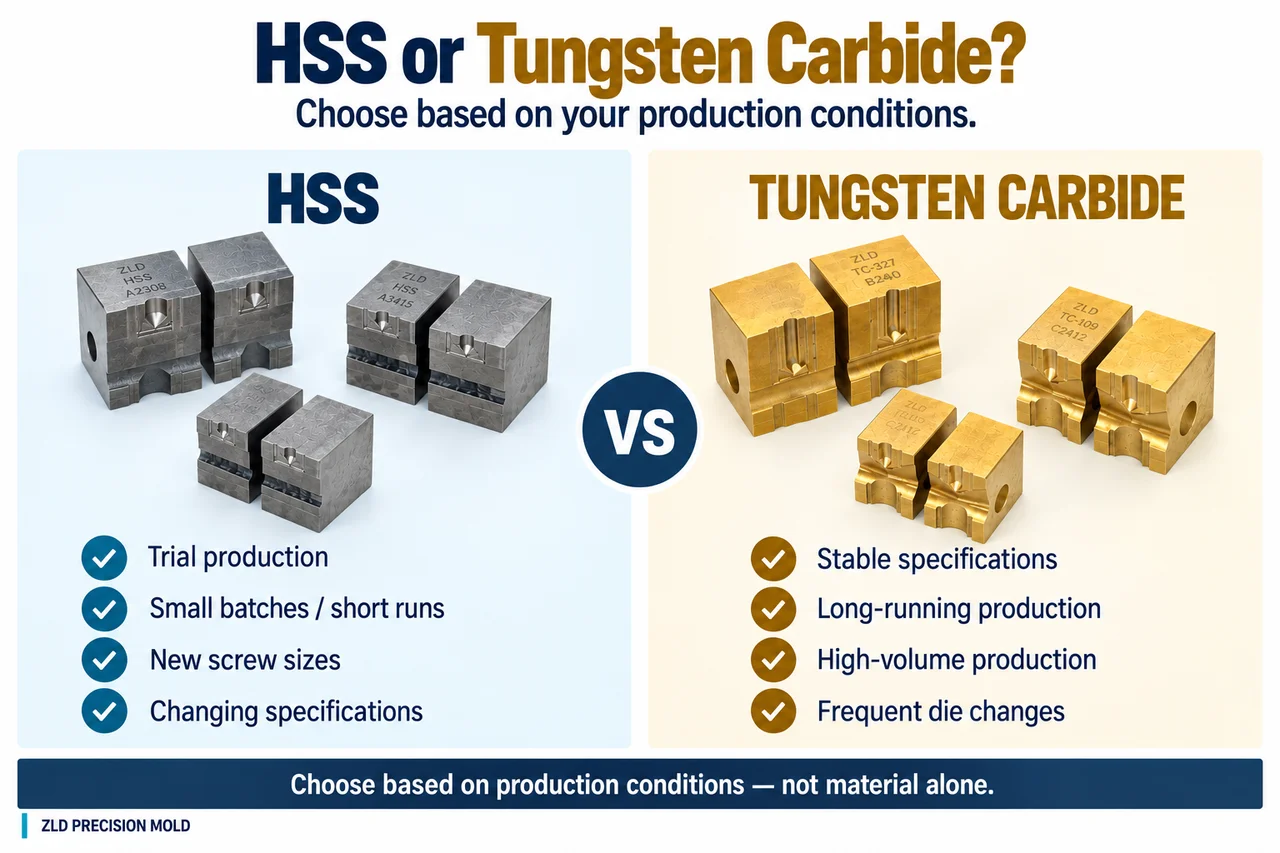
When Does an HSS Drill Point Die Make Sense?
HSS can be a practical choice when production is still flexible or the specification has not yet been fully validated.
1. Trial Production or New Screw Sizes
When testing a new self-drilling screw size or drill-point geometry, the final production requirement may still change. In this stage, committing immediately to a higher initial tooling investment may not always be necessary.
HSS can provide a practical way to validate:
- screw geometry
- machine setup
- production stability
- actual tooling requirement
before deciding whether a longer-life tooling solution is justified.
2. Small Batches or Short Production Runs
For relatively short production runs, maximum die life may not be the most important factor.
If a die is unlikely to remain in production long enough to fully use the potential life advantage of tungsten carbide, HSS may offer a more practical balance between tooling cost and production requirement.
3. Frequent Specification Changes
Some screw manufacturers produce many different sizes instead of running only a few specifications continuously.
In this situation, the important question is not simply how often the machine changes size. The more useful question is:
How much production will each individual die actually complete before the specification changes again?
If many specifications are produced only in short campaigns, HSS may remain a practical option.
When Does a Tungsten Carbide Drill Point Die Make Sense?
Tungsten carbide becomes more attractive when production is stable, repeatable and expected to continue for a long period.
1. Stable, Fixed Specifications
Once the screw specification has been validated and is expected to remain in production, tooling life becomes more important.
The die can be used repeatedly instead of being replaced because the product itself has changed. This gives manufacturers more opportunity to benefit from a longer-life tooling solution.
2. Long-Running or High-Volume Production
In continuous production, the purchase price of one die is only part of the tooling cost. Other factors become increasingly important:
- actual die life
- total good output per die
- replacement frequency
- die-change time
- production interruptions
In these conditions, tungsten carbide is often worth evaluating even when the initial tooling cost is higher.
3. Frequent Die Changes Are Affecting Production
A die change creates more than the cost of buying another tool. It can also involve:
- machine stoppage
- operator time
- setup and adjustment
- production interruption
- additional process variation after replacement
If die replacement is becoming a meaningful part of production cost, tungsten carbide may provide better overall tooling economics.
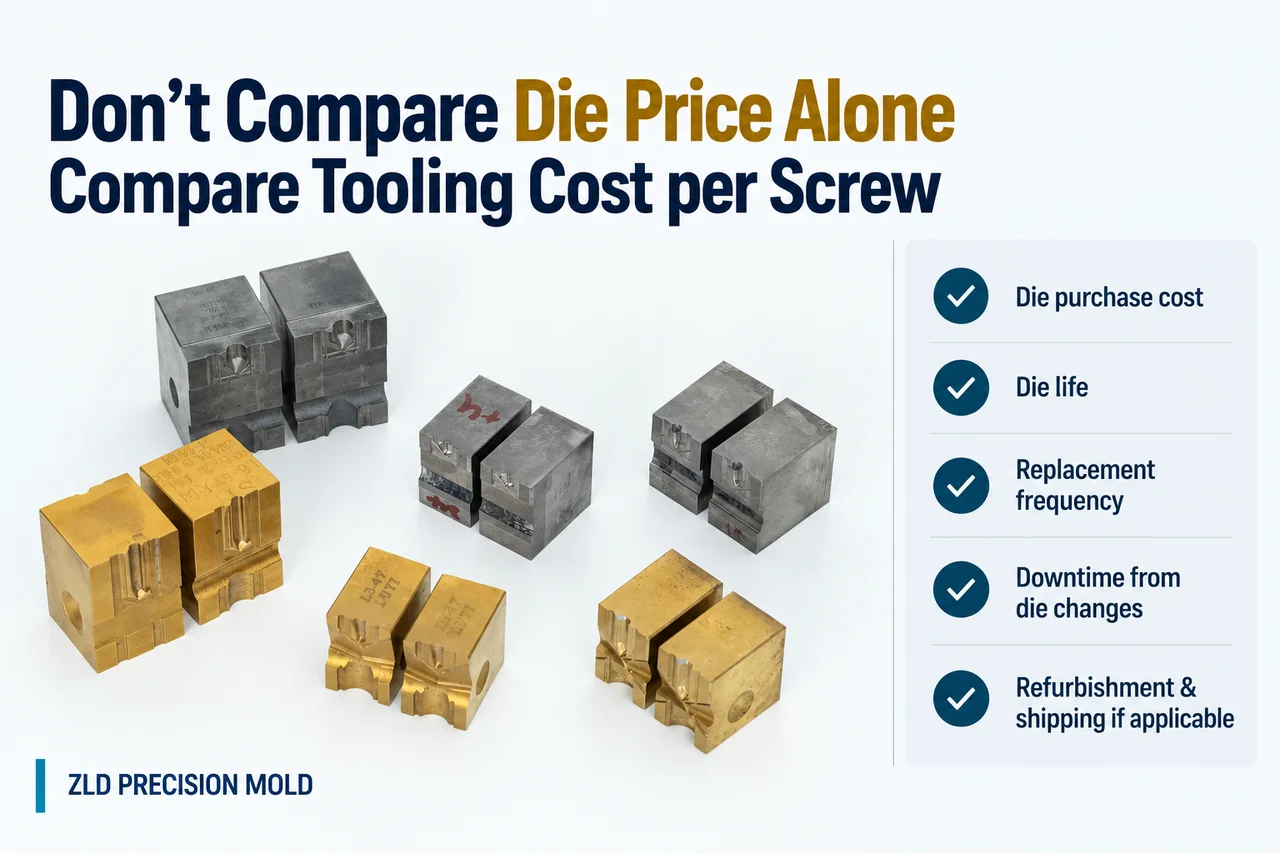
Don't Compare Die Price Alone
A common purchasing mistake is to compare only HSS die price vs tungsten carbide die price.
A lower-priced die is not automatically the lower-cost option. For stable production, a more useful comparison is:
Tooling Cost per Screw = Total Tooling-Related Cost ÷ Total Good Screws Produced
Depending on the factory, tooling-related cost may include:
- die purchase cost
- replacement frequency
- downtime associated with die changes
- refurbishment or regrinding, where applicable
- logistics or return cost, where applicable
Consider two dies:
Die A
- lower purchase price
- shorter service life
- more frequent replacement
Die B
- higher purchase price
- longer service life
- fewer die changes
If you compare only the purchase price, Die A appears cheaper. But if Die B produces significantly more good screws before replacement and reduces production interruptions, its tooling cost per screw may be lower.
The break-even point will be different for every factory. That is why actual production volume and actual die performance matter more than the price of one individual die.
Short Die Life? Don't Change Material First
If your current drill point die is wearing out much earlier than expected, changing from HSS to tungsten carbide does not automatically solve the problem.
Unexpectedly short die life can also be caused by the production process. Before changing die material, check the following.
Machine Condition
Machine wear, looseness, runout or unstable operation can change the load applied to the die.
Die Alignment
Incorrect installation or poor alignment can create uneven loading and abnormal wear.
Wire or Screw Blank Material
Material grade, hardness, surface condition and batch consistency can affect tooling load and die performance.
Production Setup
Forming speed, lubrication, machine settings and overall process stability can also influence die life.
So when a die fails much earlier than expected, the first question should not always be "Should we change to tungsten carbide?"
A better question is "Why is the current die life shorter than expected?"
Identify the cause first, then decide whether changing die material is the right solution.
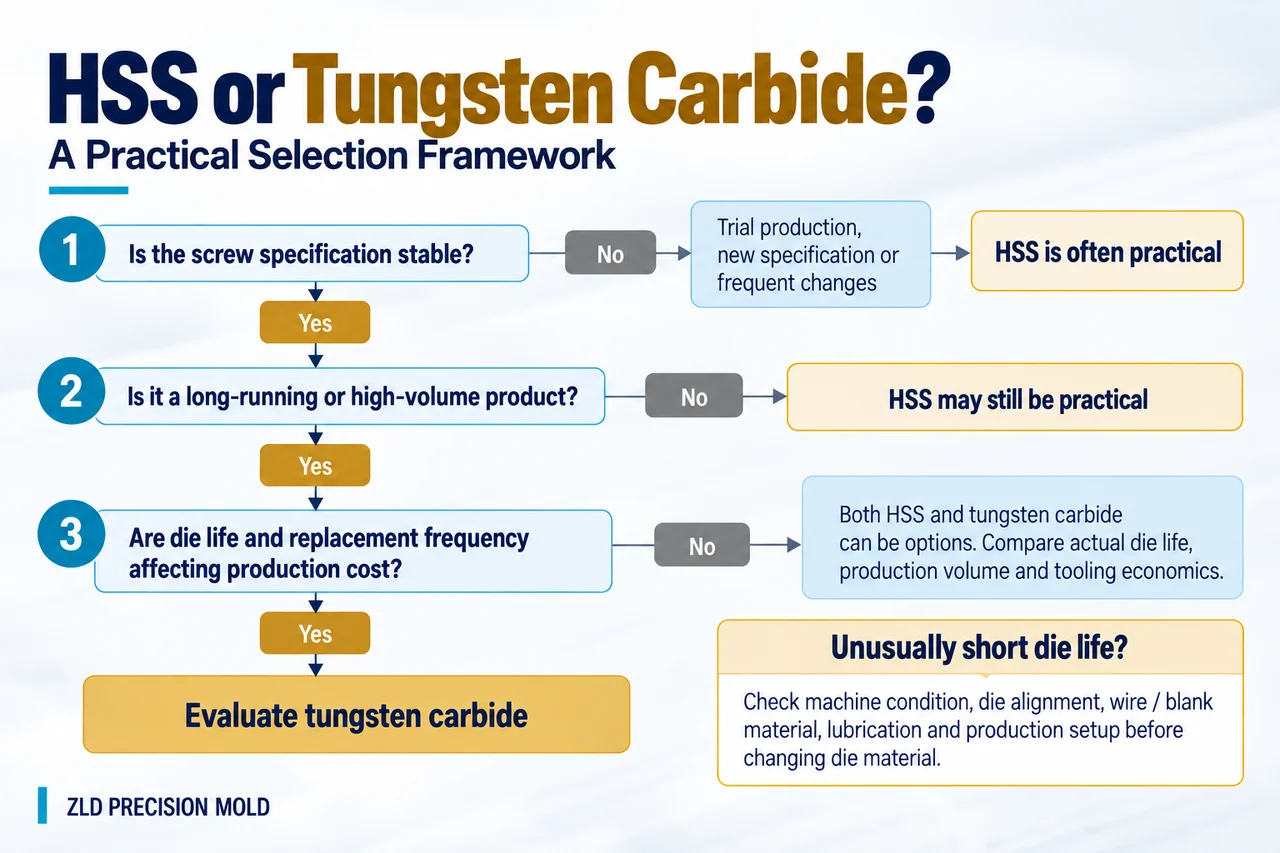
A Practical HSS vs Tungsten Carbide Selection Framework
Before selecting the material, first confirm that the die design matches the screw specification, machine and production requirement.
Step 1 — Is the screw specification stable?
- No — trial production, new specifications or frequent changes → HSS is often practical
- Yes — continue to Step 2
Step 2 — Is this a long-running or high-volume product?
- No — short production runs or occasional orders → HSS may still be practical
- Yes — continue to Step 3
Step 3 — Are die life and replacement frequency affecting production cost?
- Yes → Evaluate tungsten carbide
- No → Both materials can be options. Compare actual die life, production volume and tooling economics.
One More Check
If die life is unexpectedly short, first check machine condition, die alignment, wire or screw blank material, lubrication and production setup before changing the die material.
This is a simplified selection framework. Actual production conditions can change the recommendation.
Drill Point Die Selector
Enter screw size and plate thickness to get the matching die code
Open the selector toolWhat Information Should You Send Your Die Supplier?
If you are not sure which material fits your production, sending only a screw size is usually not enough. The more useful information includes:
1. Screw Specification
Provide one or more of the following:
- screw standard and size
- technical drawing
- existing screw sample
- drill-point geometry
- existing die dimensions or photos
2. Wire or Screw Blank Material
If available, provide:
- material grade
- hardness
- surface condition
- other relevant material information
3. Production Requirement
Tell the supplier whether this is trial production, small-batch production, repeat production or continuous high-volume production. Approximate production volume is also useful.
4. Current Die Life
If the screw is already in production, provide:
- current die material
- approximate good output per die
- replacement frequency
- abnormal wear or breakage
- any production problem you are trying to solve
5. Machine and Tooling Information
If available, provide:
- machine model
- existing die dimensions
- die-pocket dimensions
- photos of the existing tooling setup
This helps the supplier evaluate both material selection and die compatibility.
Which one for your line?
Send your screw size, wire material and current die life — we'll give you a judgement based on your actual production.
Ask our engineersHSS or Tungsten Carbide: The Final Decision
There is no single material that is best for every self-drilling screw production line.
HSS often makes sense when:
- a new screw size is being tested
- specifications are still changing
- production runs are relatively short
- many specifications are produced in small campaigns
- lower initial tooling commitment is important
Tungsten carbide becomes more attractive when:
- specifications are stable
- production runs are long
- production volume is high
- die changes are affecting production efficiency
- longer die life can reduce overall tooling cost
The key is to evaluate the die as part of the complete production process. Don't compare die price alone. Compare tooling cost per screw.
If you need the underlying material detail — carbide grades, cobalt binder percentages, HSS alloys and PVD coating options — see the drill point die material selection guide.
Need Help Choosing HSS or Tungsten Carbide?
If you are evaluating a new drill point die, send us:
Screw size + wire or screw blank material + production volume + current die life
If available, you can also send a drawing, screw sample, existing die photos or machine information.
ZLD Precision Mold produces HSS and tungsten carbide drill point dies for self-drilling screw production. Standard and custom dies can be made according to drawing, sample or production requirement.
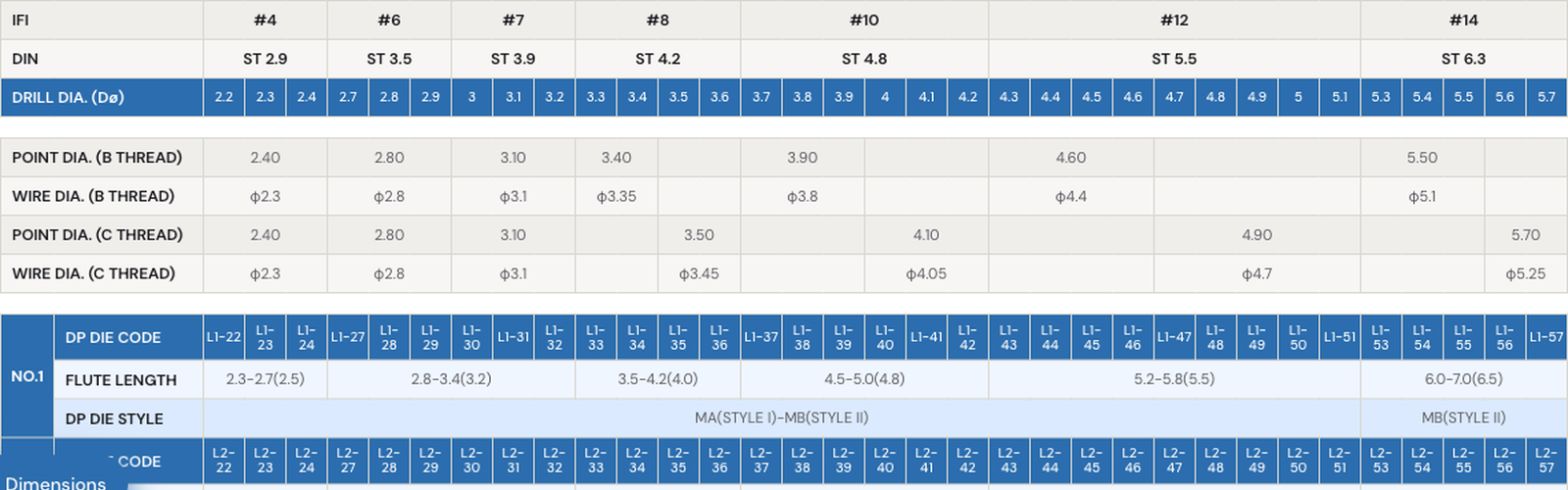
Full spec table: 33 drill diameters × L1–L7
Find the drill point die code for IFI #4–#14 / DIN ST2.9–ST6.3
View full spec tableSend your requirement — or use the WhatsApp button on this page if you prefer to send photos and drawings directly.
Frequently Asked Questions
Is tungsten carbide always better than HSS for drill point dies?
No. Tungsten carbide is often worth evaluating for stable, long-running and high-volume production. HSS can remain practical for trial production, short production runs or specifications that are still changing. The final choice should also consider actual material, machine condition, production setup and die-life requirement.
Why use HSS if tungsten carbide can provide longer die life?
Because maximum die life is not always the main production objective. For a new specification or a short production run, production flexibility and initial tooling commitment may matter more than maximizing the life of one die.
Should I switch to tungsten carbide if my HSS die life is too short?
Not automatically. First determine whether abnormal wear is being caused by machine condition, alignment, material variation, lubrication or production setup. If the process is stable and die replacement is still too frequent, then tungsten carbide is worth evaluating.