
Does a Longer Drill Point Mean Higher Drilling Capacity?
Learn why drill-point length alone does not establish a self-drilling screw's drilling capacity, and what to check before selecting the matching drill-point die.
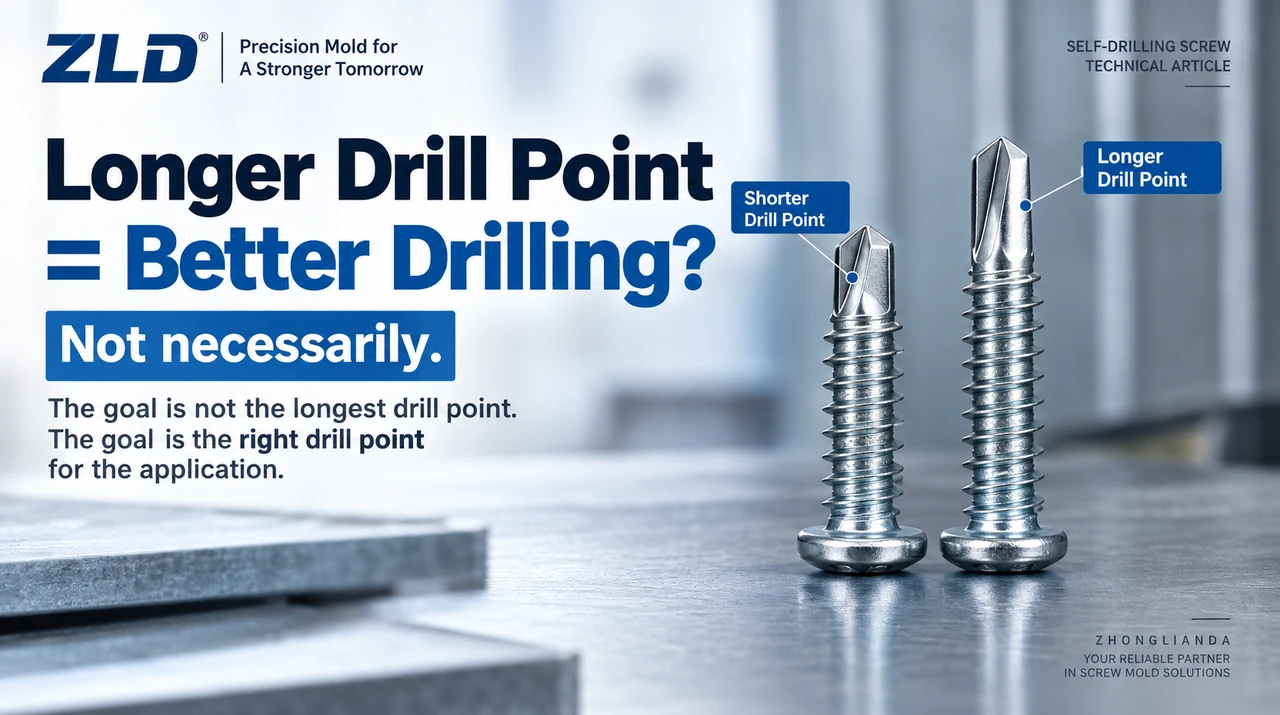
Quick answer: A longer drill point may help a correctly designed self-drilling screw reach through a particular material stack before its threads engage. It does not automatically give the finished screw a higher drilling capacity. Length is one dimension of a point; drilling capacity is a performance result for a specified material and installation procedure. To select a drill-point die, begin with the finished screw's required point drawing and drilling test, then match the die and forming process to that geometry.
1. What do “drill-point length” and “drilling capacity” mean?
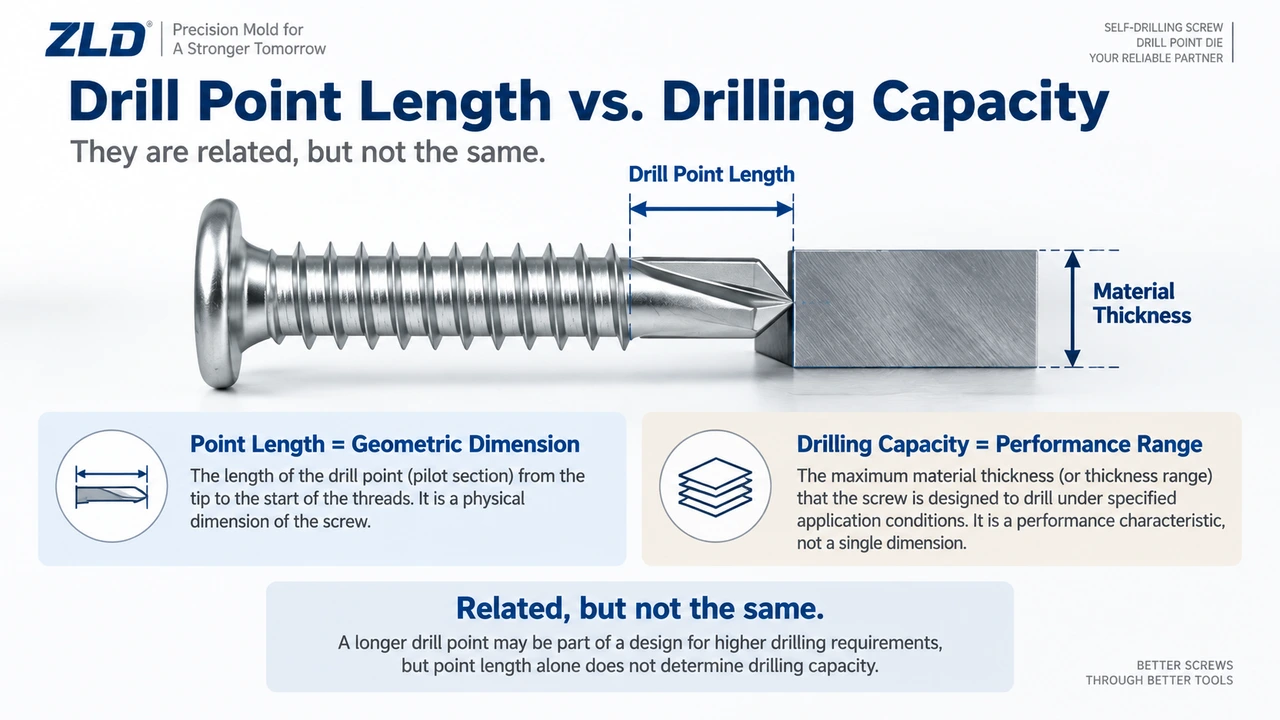
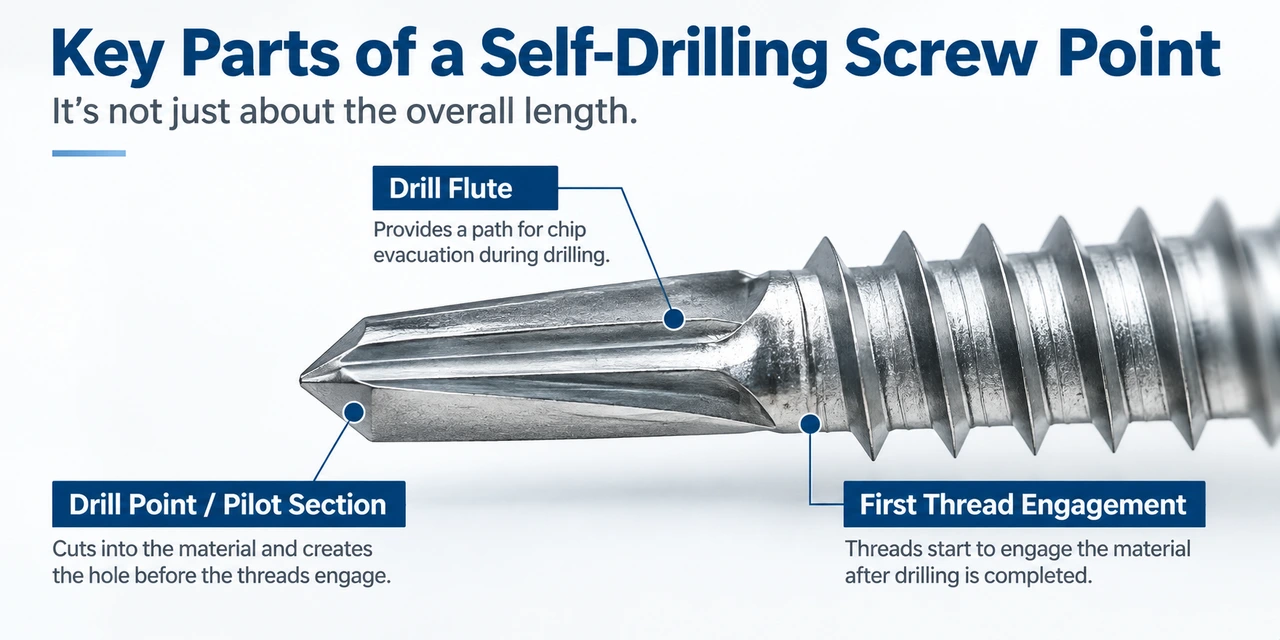
A self-drilling screw has cutting edges at its tip and flutes behind them. During installation, the tip cuts a hole and the flutes give chips a way out. Point length is a drawing dimension; overall point length and flute length may differ, so compare the same datum.
Drilling capacity describes what thickness, or thickness range, a finished screw can penetrate in a stated material and test arrangement. This distinction matters when a sample is sent to a die maker. The screw point actually performs the cutting during installation. The drill-point die cold-forms that point at the screw factory; it never contacts the steel sheet being installed.
2. Why does length matter without defining capacity?
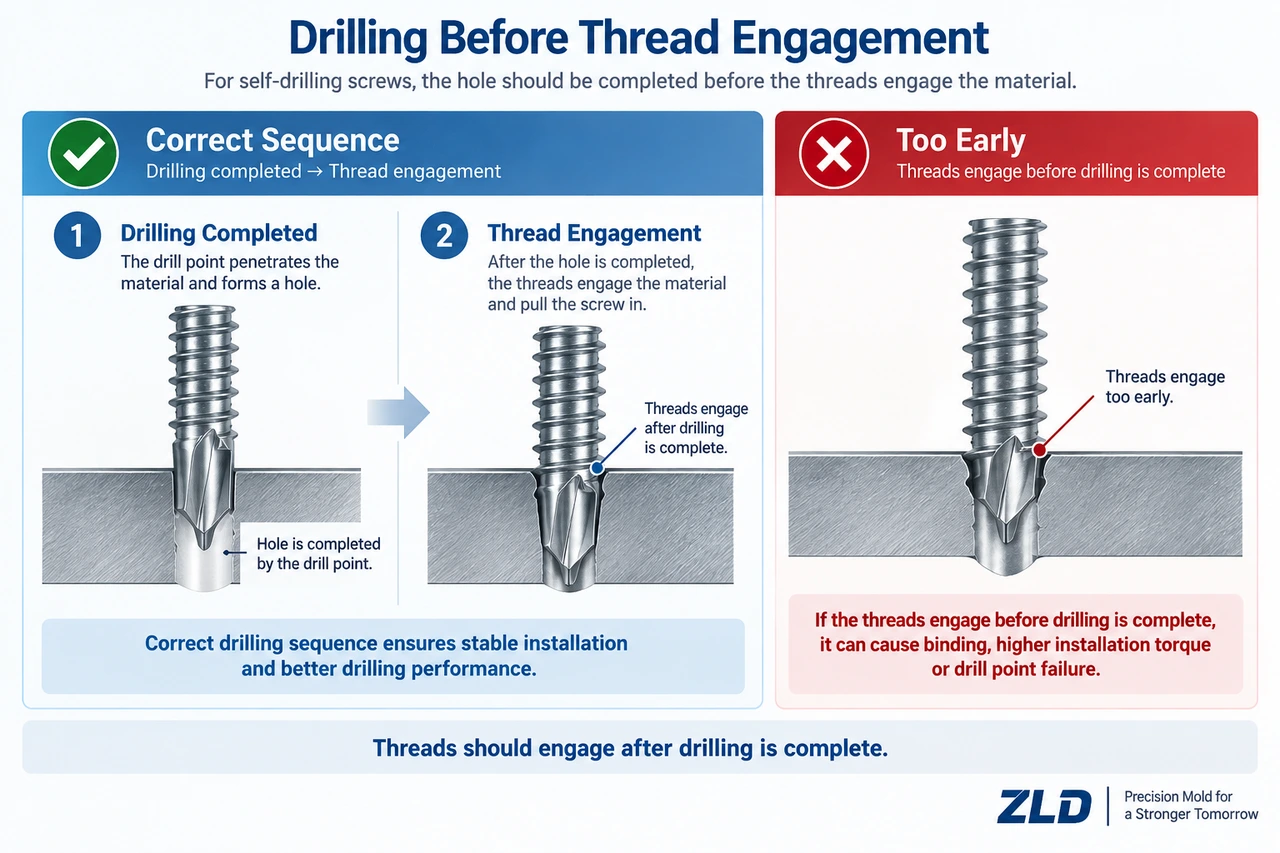
A drill point needs enough suitable geometry to pass through the intended material before the threads begin to pull the screw forward. If the thread catches while the tip is still cutting, it can force advance faster than the point can remove material. That mismatch may increase heat, damage the point or leave an unacceptable hole. Thicker stacks may require longer effective point and flute geometry, but there is no universal length-to-capacity conversion.
Extending one dimension alone cannot establish cutting quality or thread engagement. Start from the specified joint and a finished-screw test, then confirm which point dimensions are needed.
3. Why can a longer point be the wrong answer?
Thin-sheet fit and hole size
A screw intended for high drilling capacity may be a poor match for thin sheet. Its point design can leave a hole or engagement sequence that gives the threads too little useful material to grip. Check the approved sheet range and joint requirements rather than ranking points by length.
Drilling before thread engagement
The drill should make the required hole before the thread drives the fastener into the workpiece. If engagement begins too early, forced advance can overload or overheat the tip. Do not assume that simply adding flute length resolves a mismatch caused by geometry, screw specification or installation settings.
Chip clearance along the flute
Flutes carry cut material away from the hole. A point can have adequate reach yet still cut poorly if chips cannot leave: when the working flutes are completely embedded in the material, chip packing and heat can damage the point. Flute cross-section, cutting-edge form and the material being drilled matter along with flute length.
Material and installation conditions
A screw may behave differently in another steel grade, a coated sheet or a multilayer stack. Driver speed, axial pressure, alignment and the specified installation method also affect cutting and heat. Too much speed can burn the point; insufficient speed can impair chip removal in some systems. Test the actual assembly under the fastener supplier's instructions, without assuming universal RPM.
4. Six factors to check before choosing the point
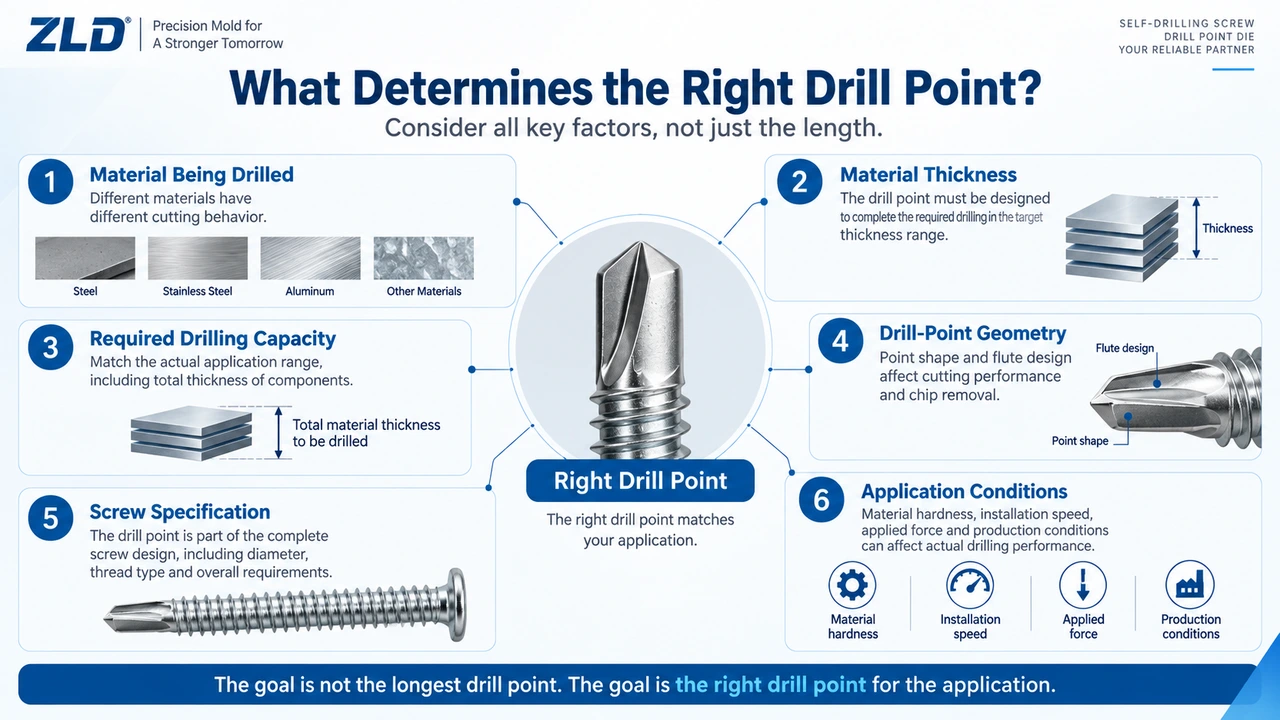
- Material being drilled. Identify each substrate and its relevant grade or condition. “Steel” alone does not describe the cutting challenge. Coatings and mixed-material layers may change the result.
- Actual thickness and stack. Record individual layer thicknesses, total thickness and any gaps. A nominal combined thickness may hide the order in which the point meets layers and when the thread starts to engage.
- Required drilling performance. Specify the approved screw's capacity requirement and how it will be verified: the test material, drilling procedure, hole quality and any joint-performance criteria. A successful hole is not proof of a suitable load-bearing connection.
- Point geometry. Compare effective point length, flute length and profile, cutting edges, web, tip shape and point-to-thread transition on the drawing or sample. Do not infer these features from a single length or a series name.
- Screw specification. Provide nominal diameter and relevant thread, material and heat-treatment requirements. Two screws of the same diameter can require different points, and a die must form the intended point on the specified blank.
- Installation conditions. Record tool settings, alignment, feed or pressure method, assembly access and observed failures. Follow the intended equipment and supplier instructions.
5. What does this mean for drill-point die selection?
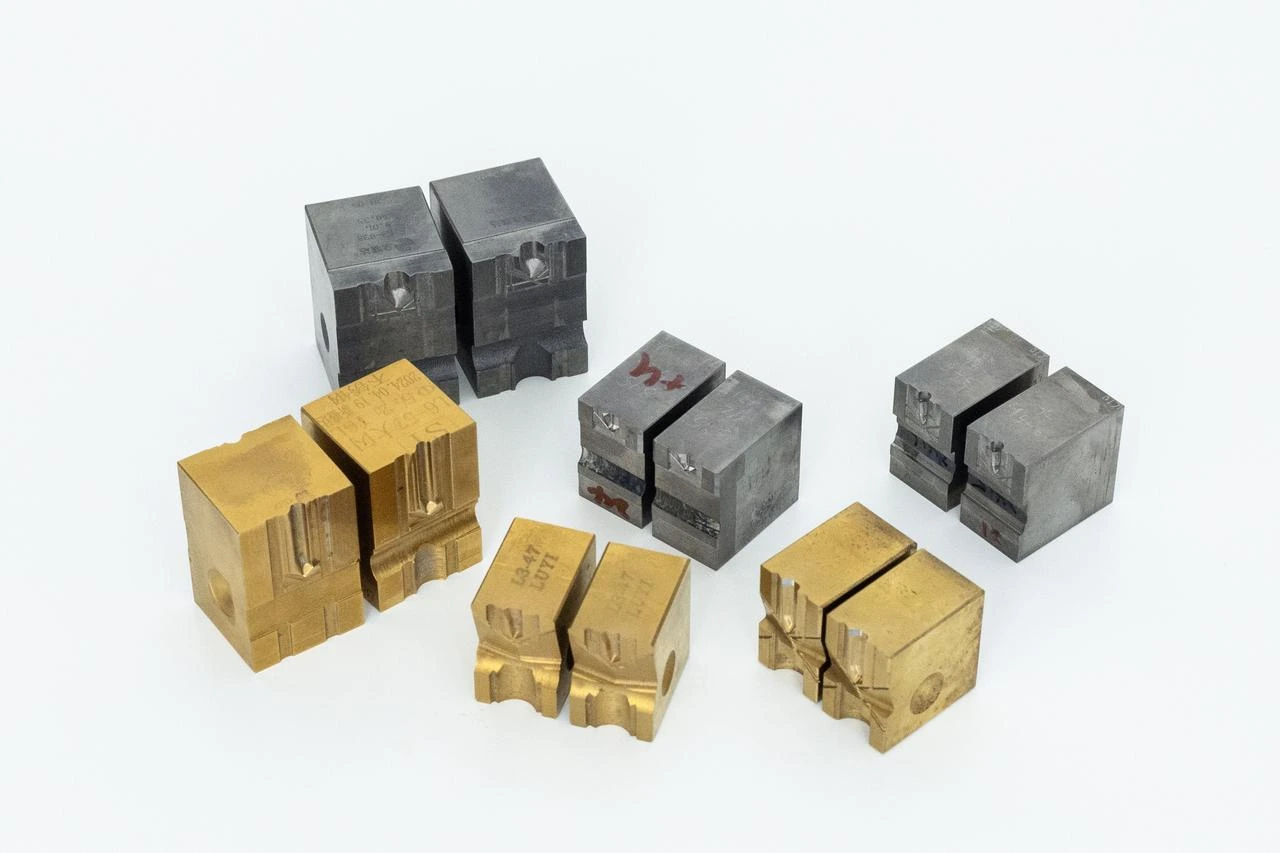
First define the point that the finished screw must have. Then choose or design a matched drill-point die capable of forming that geometry from the specified screw blank in the available machine. The die maker needs to check cavity and flute shape, dimensions, die style and machine interface. Wire condition, blank volume, alignment and forming load also affect whether the intended point fills cleanly and repeats in production. Our comparison of same-diameter screws with different drill points develops that distinction. A manufacturer's catalog flute dimension describes available geometry; no L-series or flute-length number alone assigns a certified drilling capacity.
After selecting a candidate die, inspect trial-formed points against the drawing. Separately test the finished screws in the specified assembly. If the point is incomplete or asymmetric, investigate the forming setup and die.
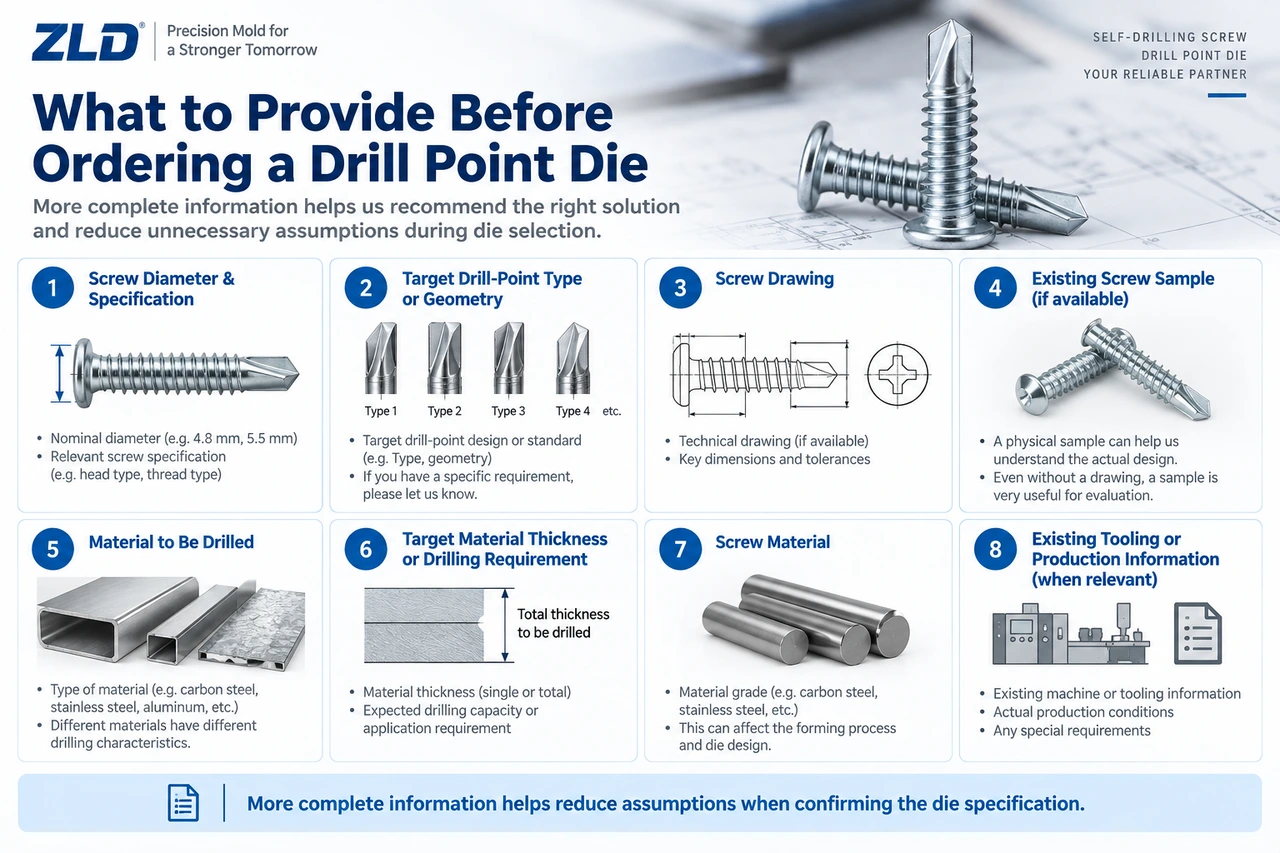
6. What information should a buyer send?
A useful starting package contains the screw diameter and specification, the target drill-point geometry, and a drawing or physical screw sample. Add the material or materials to be drilled, their individual thicknesses and stack arrangement, and the screw material or wire grade if known. If production is already running, share the current die code or photos, point measurements, machine interface, accepted output and the failure that prompted the inquiry. A sample plus the application can be enough to identify which dimensions or tests are missing.
7. A practical conclusion
Point length matters because the drill must work through the intended assembly before thread engagement, while its flutes must still remove chips. Yet a longer point is not a stand-alone capacity rating or an automatic improvement. Define the finished screw's drilling and joint requirements, compare the complete point geometry, and test the screw in the real application.
References
- EJOT, “Drilling capacity explained” — drilling capacity and the interaction of point length and diameter in product design.
- EJOT, “Avoid assembly errors with self-drilling screws” — thin-sheet mismatch, premature thread engagement and installation-speed effects.
- Simpson Strong-Tie, “Self-Drilling Screws” technical notes — pilot-point reach, thread engagement and flute clearance in the finished screw.
Frequently Asked Questions
Does a longer drill point always drill thicker steel?
No. More point length can be necessary for a specified material stack, but it does not by itself certify drilling through thicker steel. Cutting geometry, chip removal, screw design and installation conditions must work together, then be checked on the finished screw.
Is drill-point length the same as drilling capacity?
No. Length is a geometric dimension. Drilling capacity is the material thickness or range that the finished screw can drill under stated test and installation conditions. A dimension alone is not a performance rating.
Why are the drill-point flutes important?
The flutes provide a route for chips to leave the hole. If the geometry or material stack prevents chips from clearing, heat and damage can build up even when the point is long enough to reach through the material.
Can I choose a drill-point die from sheet thickness alone?
No. Sheet thickness is useful, but the material and stack, required finished-screw performance, point drawing, screw size, wire and forming-machine interface also matter. Confirm the die against the intended point and a production trial.
What should I provide when asking for a drill-point die?
Start with the screw size, target point geometry, a drawing or sample, material and thickness to be drilled, screw material, and any existing die or production information. Send what is available; missing details can be clarified before a die specification is finalized.
WHEN YOU ARE READY
Get a Die Recommendation for Your Screw
Share your screw size, drawing, sample photo, or drilling thickness. Our engineering team can help identify the relevant drill-point die specification before quotation.