
Same 5.5 mm Diameter, Different Drill Points: Why?
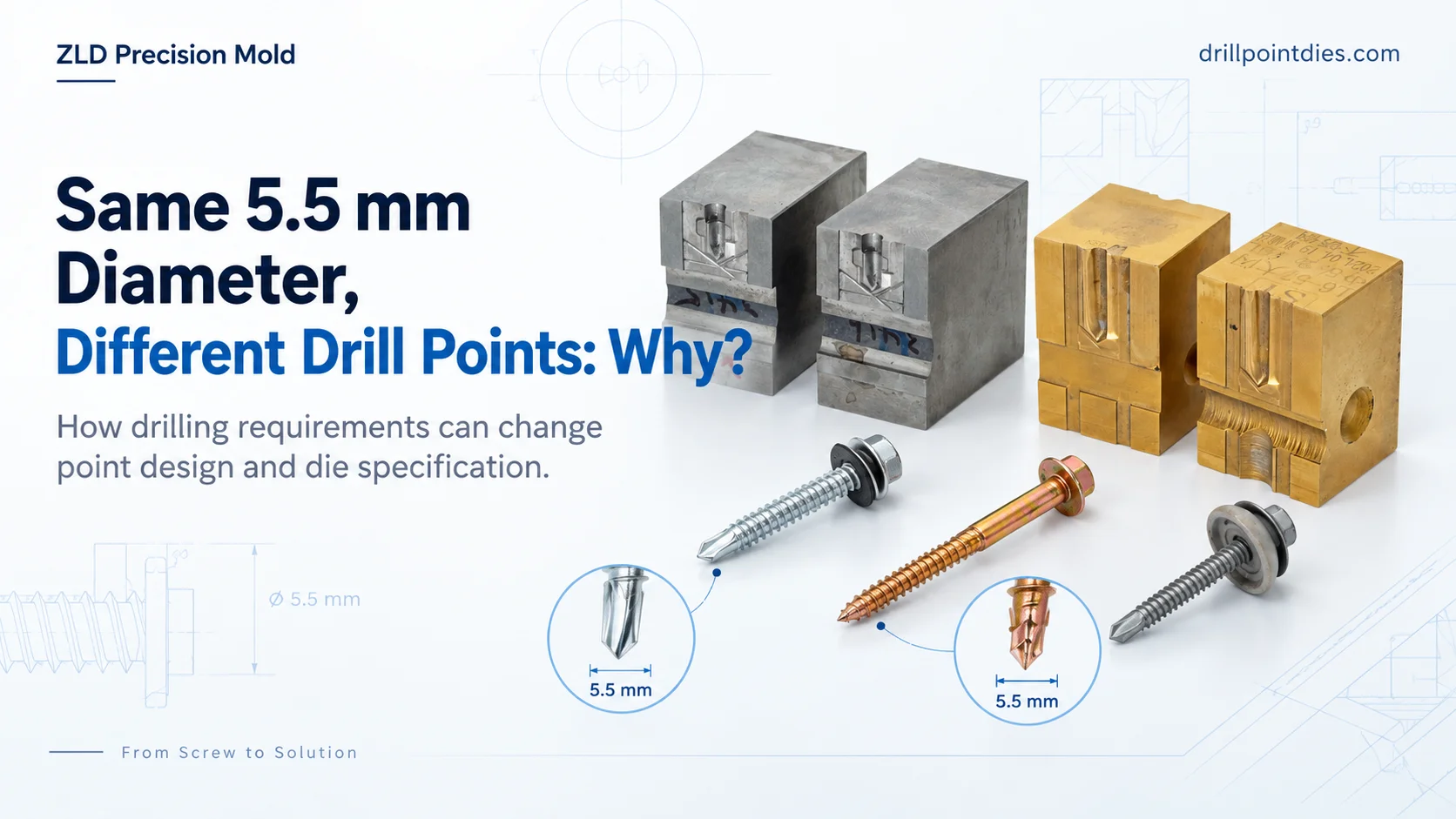
Why do two self-drilling screws with the same 5.5 mm nominal diameter need different drill-point specifications? Substrate thickness, drilling capacity and material all change point geometry — and therefore die specification. Diameter is the starting point, not the full spec.
Quick Answer
Two self-drilling screws can have the same 5.5 mm nominal diameter and still require different drill-point specifications.
The reason is simple: screw diameter is only one parameter.
The material being drilled, material thickness, required drilling capacity, and drill-point geometry all affect how the point needs to perform.
When the required drill-point geometry changes, the matching drill-point die specification may also need to change.
Screw Diameter Alone Does Not Define the Drill Point
A 5.5 mm diameter tells us the nominal size of the screw, but it does not fully define the drilling requirement.
A self-drilling screw works as both a cutting tool and a fastener. Before the threads can properly engage with the material, the drill point must first penetrate the workpiece and create the required hole.
This means that two screws with the same nominal diameter can still operate under very different drilling conditions.
Material Thickness Changes the Drilling Requirement
One of the most important factors is the thickness of the material being drilled.
The drill point needs sufficient length and cutting capability to penetrate the material before the threads begin to engage.
If thread engagement starts before the drill point has fully penetrated the material, chip evacuation may become more difficult, while heat and drilling resistance may increase. In severe cases, this can contribute to binding or screw breakage.
For this reason, point length is closely related to the thickness the screw is designed to drill through — which is why the drill point die selection guide starts with substrate thickness before narrowing down the L-series.
Drilling Capacity Is Different From Screw Length
Another important concept is drilling capacity.
Drilling capacity describes the material thickness range that the drill point is designed to penetrate. It is different from the overall length of the screw.
A longer screw does not automatically provide greater drilling capacity.
The drilling requirement depends primarily on the design and geometry of the drill point itself.
Therefore, when selecting or matching a drill-point die, it is not enough to look only at:
-
Screw diameter
-
Overall screw length
The required drilling capacity also needs to be considered.
What Can Be Different Even at the Same Diameter?
Even when the nominal screw diameter remains the same, the drill point may differ in several important areas:
-
Point length
-
Flute length and flute geometry
-
Cutting-edge geometry
-
Point shape and angle
-
Overall drilling capacity
These features influence how the screw begins cutting, removes chips, manages heat, and transitions from drilling into thread engagement.
So, two 5.5 mm self-drilling screws may look similar in overall size while having noticeably different drill-point designs.
Why Can the Drill-Point Die Be Different Too?
The drill-point die is used to form the required geometry of the screw's drill point.
If the required point length, flute geometry, cutting-edge geometry, or other drill-point features change, the die must also be designed to form that geometry correctly.
The practical relationship is:
Drilling Requirement → Drill-Point Specification → Drill-Point Die Specification
This is why screw diameter alone is not enough to define a drill-point die.
A 5.5 mm self-drilling screw does not automatically correspond to one fixed drill-point die specification. To find the specific die code, cross-reference drill diameter and L-series in the full specification table.
Material Also Matters
The type and hardness of the material being drilled also affect drilling performance.
Steel, stainless steel, aluminum, and other materials do not behave in exactly the same way during cutting.
Different materials can create different requirements for:
-
Cutting conditions
-
Heat management
-
Chip evacuation
-
Drill-point durability
For harder or more difficult-to-machine materials, these factors become especially important.
For this reason, drill-point selection should always be connected to the actual application rather than being based on screw diameter alone.
How Do You Match the Right Drill-Point Die?
In actual production, the most reliable starting point is usually the information you already have.
Useful references can include:
-
Technical drawing
-
Screw sample
-
Existing drill-point die
-
Clear photos of the existing die
-
Trial-run or production video
These references help engineers review the existing drill-point geometry and better understand the actual production requirement.
From there, the drill-point die specification can be checked more accurately before sampling and trial production.
Instead of simply telling a supplier:
"I need a 5.5 mm drill-point die."
it is much more useful to provide the actual screw, drawing, existing die, or production reference.
This helps reduce uncertainty and improves the accuracy of die matching.
Checking drilling capacity for your screw?
Send your screw size, drilling thickness and a drawing if you have one. We can help check the matching die.
Conclusion
The key point is simple:
Same diameter does not always mean the same drill point.
Two 5.5 mm self-drilling screws may be designed for different materials, different material thicknesses, and different drilling-capacity requirements.
These differences can lead to different drill-point geometries — and therefore different drill-point die specifications.
For drill-point die matching, diameter is only the starting point, not the complete specification.
Need help checking a drill-point die specification? Send your drawing, screw sample, existing die, die photos or trial-run video to our engineers for technical review.
Frequently Asked Questions
Why can two self-drilling screws of the same 5.5 mm diameter need different drill points?
Because screw diameter is only one parameter. The material being drilled, its thickness, the required drilling capacity and the drill-point geometry all affect how the point has to perform. When the required point geometry changes, the matching drill-point die specification may need to change with it.
Is drilling capacity the same thing as screw length?
No. Drilling capacity describes the material thickness range the drill point is designed to penetrate, and it depends on the design and geometry of the point itself. A longer screw does not automatically provide greater drilling capacity. When matching a die, drilling capacity has to be considered alongside diameter and overall length.
At the same diameter, what can actually differ on the drill point?
Common differences include point length, flute length and flute geometry, cutting-edge geometry, point shape and angle, and overall drilling capacity. These features influence how the screw begins cutting, removes chips, manages heat, and transitions from drilling into thread engagement.
Is diameter enough information to quote a drill point die?
Usually not. It is far more effective to provide a technical drawing, a screw sample, the existing die or clear photos of it, or a trial-run or production video. These let engineers review the existing point geometry and confirm the die specification more accurately before sampling and trial production.
WHEN YOU ARE READY
Get a Die Recommendation for Your Screw
Share what you already have. Our engineering team can review the information and help identify a suitable drill-point die specification before quotation.