
Self-Drilling Screw Sizes: Complete IFI & DIN Cross-Reference Guide
Cross-reference guide for self-drilling screw sizes between IFI (#4-#14) and DIN (ST2.9-ST6.3) standards. Includes drill diameters, wire diameters, and matching drill point die specifications.
Understanding Self-Drilling Screw Size Standards
Self-drilling screws are sized using two major international standards:
- IFI (Industrial Fasteners Institute) — The American standard, using number designations (#4, #6, #7, #8, #10, #12, #14)
- DIN (Deutsches Institut für Normung) — The European standard, using ST (self-tapping) metric designations (ST2.9, ST3.5, ST3.9, ST4.2, ST4.8, ST5.5, ST6.3)
Both standards cover similar screw size ranges and can be approximately cross-referenced. However, they are not simply different names for identical specifications — they differ in tolerances, test methods, and material requirements. If you're exporting screws internationally, you need to understand both systems.
Complete IFI to DIN Cross-Reference
| IFI Size | DIN Size | Major Diameter (mm) | Drill Diameter Dø (mm) |
|---|---|---|---|
| #4 | ST 2.9 | 2.845 | 2.2–2.4 |
| #6 | ST 3.5 | 3.505 | 2.8–3.0 |
| #7 | ST 3.9 | 3.810 | 3.0–3.2 |
| #8 | ST 4.2 | 4.166 | 3.3–3.5 |
| #10 | ST 4.8 | 4.826 | 3.8–4.1 |
| #12 | ST 5.5 | 5.486 | 4.3–4.7 |
| #14 | ST 6.3 | 6.350 | 5.1–5.7 |
Note: Major diameter values are per IFI/DIN standards. Drill diameter (Dø) varies by series and manufacturer — the ranges shown above cover common production specifications and serve as a selection reference.
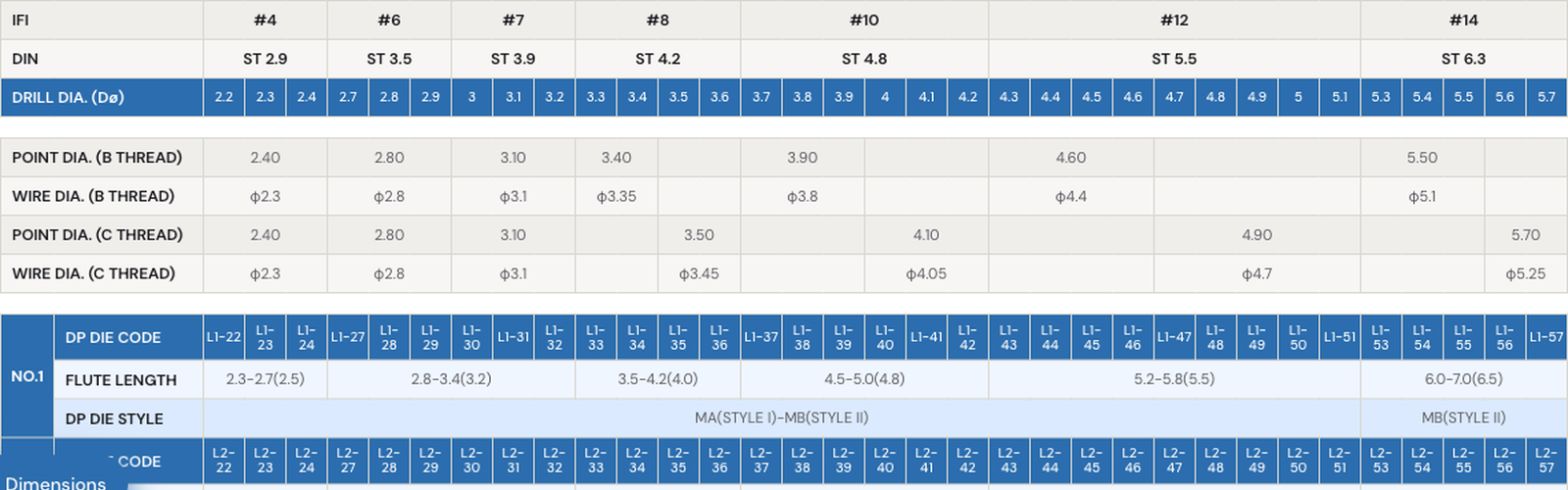
Full spec table: 33 drill diameters × L1–L7
Find the drill point die code for IFI #4–#14 / DIN ST2.9–ST6.3
View full spec tableDrill Point Die Sizes by Screw Size
Each screw size requires a specific drill point die. The die must match the screw's wire diameter, point diameter, and target drill diameter precisely. Here's how they typically map:
IFI #4 / DIN ST 2.9 (Smallest)
- Wire diameter: ~2.0 mm
- Point diameter: ~2.2 mm
- Die styles available: MA (Style I)
- Typical application: Light-gauge sheet metal, HVAC ductwork
- Available in L1–L2 series (short drill point for thin material)
IFI #6 / DIN ST 3.5
- Wire diameter: ~2.5 mm
- Point diameter: ~2.8 mm
- Die styles available: MA, MB
- Typical application: Steel studs, light framing
- Available in L1–L2 series
IFI #7 / DIN ST 3.9
- Wire diameter: ~2.8 mm
- Point diameter: ~3.0 mm
- Die styles available: MA, MB
- Typical application: Cladding, decking fasteners
- Available in L1–L3 series
IFI #8 / DIN ST 4.2
- Wire diameter: ~3.1 mm
- Point diameter: ~3.3 mm
- Die styles available: MA, MB
- Typical application: General construction, roofing
- One of the most popular sizes in many markets
- Available in L1–L3 series
IFI #10 / DIN ST 4.8
- Wire diameter: ~3.6 mm
- Point diameter: ~3.8 mm
- Die styles available: MB
- Typical application: Roofing, siding, structural connections
- Available in L1–L4 series
IFI #12 / DIN ST 5.5
- Wire diameter: ~4.1 mm
- Point diameter: ~4.3 mm
- Die styles available: MB, MC
- Typical application: Heavy-gauge steel, structural framing
- Available in L3–L6 series; MC style in L4–L7
IFI #14 / DIN ST 6.3 (Largest)
- Wire diameter: ~4.7 mm
- Point diameter: ~5.1 mm
- Die styles available: MB, MC
- Typical application: Thick structural steel, heavy industrial
- All L-series available; MC style in L4–L7
Wire and point diameters listed above are approximate common values. Always confirm exact specifications with your die supplier for your specific screw design.
Choosing the Right L-Series for Your Substrate
The L-series (L1 through L7) determines the flute length of the drill point. Longer flutes penetrate thicker material:
| Substrate Thickness | Recommended L-Series | Typical Application |
|---|---|---|
| < 1.0 mm | L1 | Thin sheet metal, HVAC |
| 1.0–2.0 mm | L1–L2 | Light-gauge steel framing |
| 2.0–4.0 mm | L2–L3 | Medium-gauge construction |
| 4.0–8.0 mm | L3–L5 | Heavy-gauge steel |
| 8.0–12.0 mm | L5–L6 | Structural steel |
| > 12.0 mm | L6–L7 | Extra-thick structural steel |
Why does one thickness map to several series? Flute length also scales with screw size — a #8 and a #14 screw going through the same 4 mm plate fall into different series. Use thickness to narrow the candidates, then your screw size to land on a specific die code.
Important: Match the L-series to the thickest material the screw must penetrate. Under-specifying leads to incomplete drilling; over-specifying wastes material and reduces assembly speed.
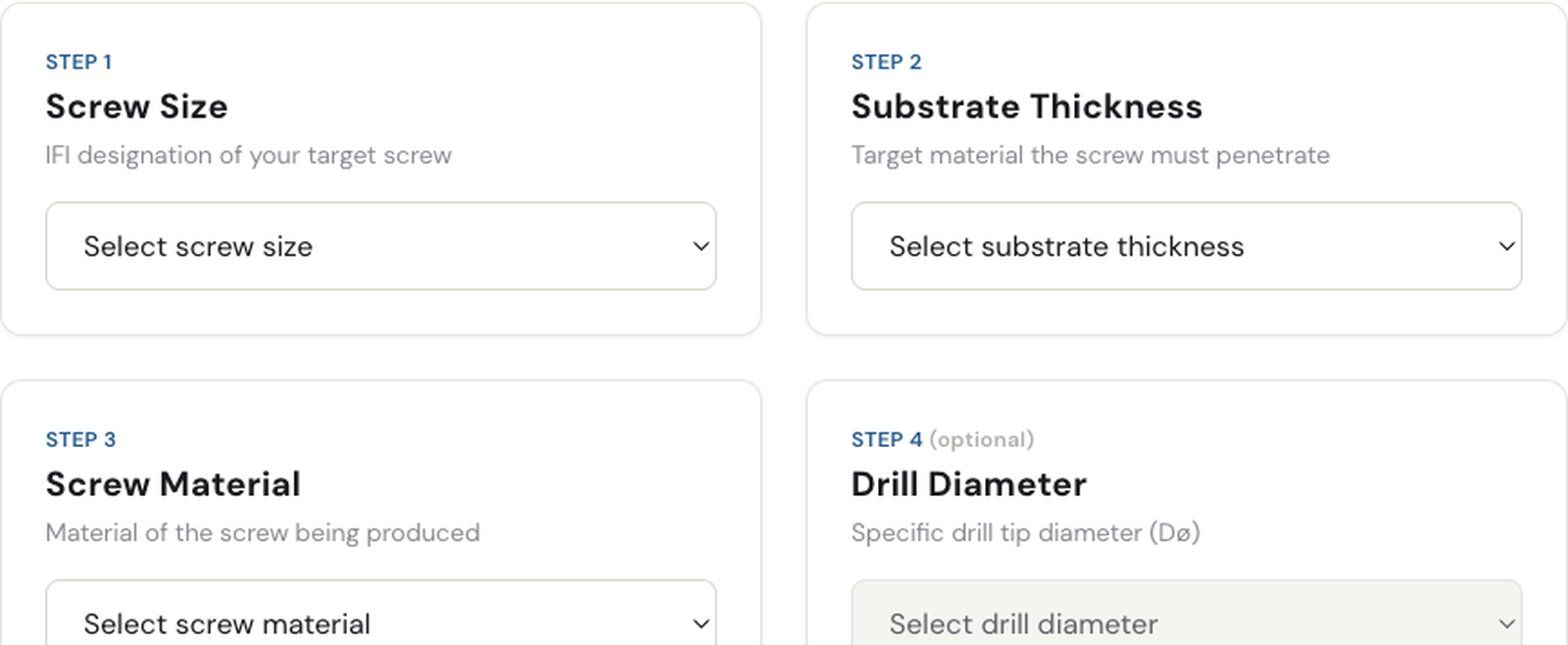
Drill Point Die Selector
Enter screw size and plate thickness to get the matching die code
Open the selector toolRegional Market Preferences
Different markets tend to favor different size ranges:
- North America — IFI #8 and #10 are among the most common in construction. IFI standard is primary.
- Europe — DIN ST4.2 and ST4.8 are widely used. DIN/ISO standards are primary.
- Southeast Asia — Mix of IFI and DIN depending on export destination. #8 and #10 are commonly popular.
- Middle East — Generally follows European DIN standards.
- Latin America — Mix of both standards; IFI is more common in countries with strong US trade ties.
Quality Specifications to Verify
When sourcing drill point dies for any screw size, these are commonly verified specifications:
- Drill diameter tolerance — A common target is ±0.02 mm of specification
- Flute surface finish — Mirror polish reduces friction and improves screw point quality
- Die concentricity — The two die halves must align precisely; misalignment creates off-center drill points
- Material certification — For carbide: cobalt content and grain size. For HSS: grade verification (M2, M9, or M51)
Find the Right Die for Your Screw Size
ZLD Precision Mold manufactures drill point dies for the full range of self-drilling screw sizes — IFI #4 through #14, DIN ST2.9 through ST6.3 — in all seven L-series. Use our interactive specification chart to find the exact die code for your screw, or contact us for custom specifications.
Related Reading
Frequently Asked Questions
How do IFI and DIN self-drilling screw sizes convert?
Common mapping: #4≈ST2.9, #6≈ST3.5, #7≈ST3.9, #8≈ST4.2, #10≈ST4.8, #12≈ST5.5, #14≈ST6.3. The two standards cover similar physical ranges but differ in tolerances, test methods, and material requirements — produce to the target market's standard.
Which sizes are most common in each market?
North American construction runs mostly IFI #8 and #10; Europe uses DIN ST4.2 and ST4.8 widely; Southeast Asia mixes both depending on export destination, with #8/#10 again most common. If you stock dies for only one or two sizes for export, #8/ST4.2 and #10/ST4.8 give the widest coverage.
How do I pick the L series by plate thickness?
Start from the thickest material the screw must penetrate; one thickness usually leaves several candidates: under 1 mm takes L1, 1–2 mm takes L1–L2, 2–4 mm takes L2–L3, 4–8 mm takes L3–L5, 8–12 mm takes L5–L6, and above 12 mm extra-thick structural steel takes L6–L7. Narrow the candidates with your screw size — flute length scales with screw size too. Too short will not drill through; too long wastes material and slows assembly.
What quality metrics should I verify when buying dies?
Four common ones: drill-diameter tolerance (±0.02 mm is a common target), flute surface finish (mirror polish reduces friction), concentricity of the two die halves (offset causes off-center points), and material certificates (cobalt content and grain size for carbide; M2/M9/M51 grade verification for HSS).