
DIN 7504 vs ISO 15480–15483: What Changes for Self-Drilling Screw Manufacturers?
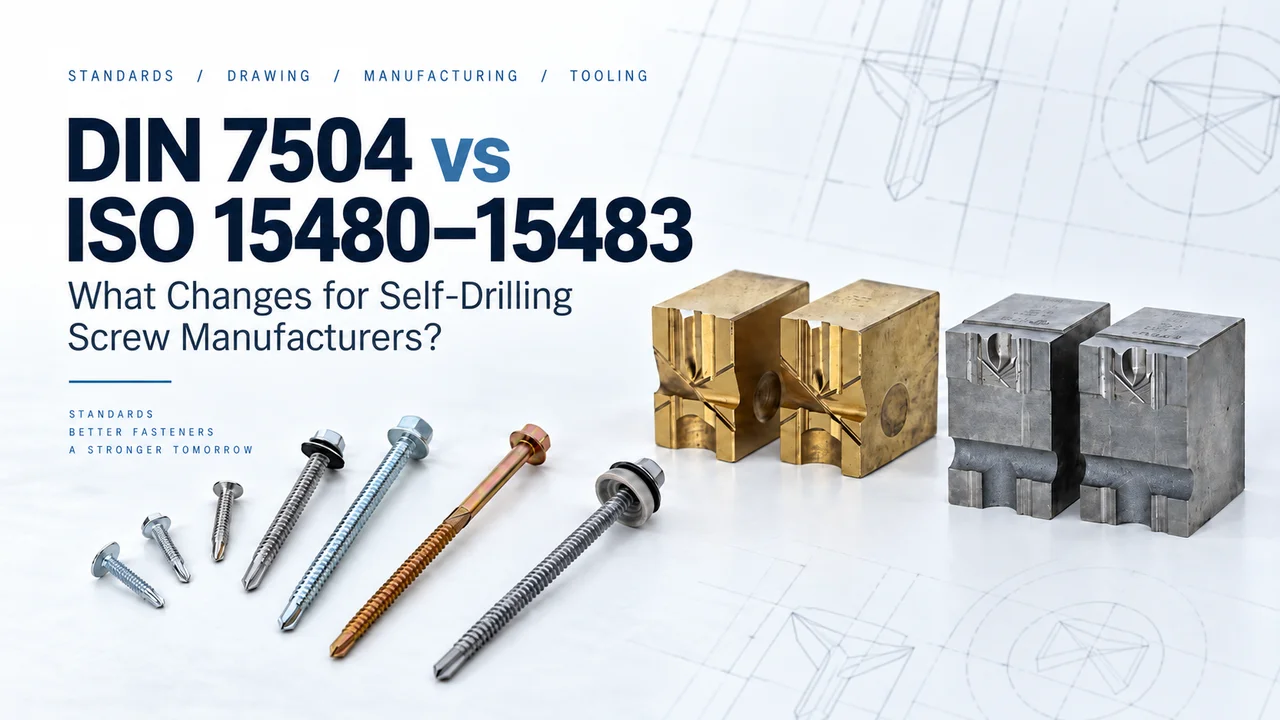
DIN 7504 was withdrawn and replaced by ISO 10666 and ISO 15480–15483 — a reorganization, not a renaming. What self-drilling screw manufacturers should recheck before changing the screw, the drawing or the drill point die.
Quick Answer
DIN 7504 and ISO 15480–15483 are closely related, but the change should not be understood as a simple renaming of the same standard.
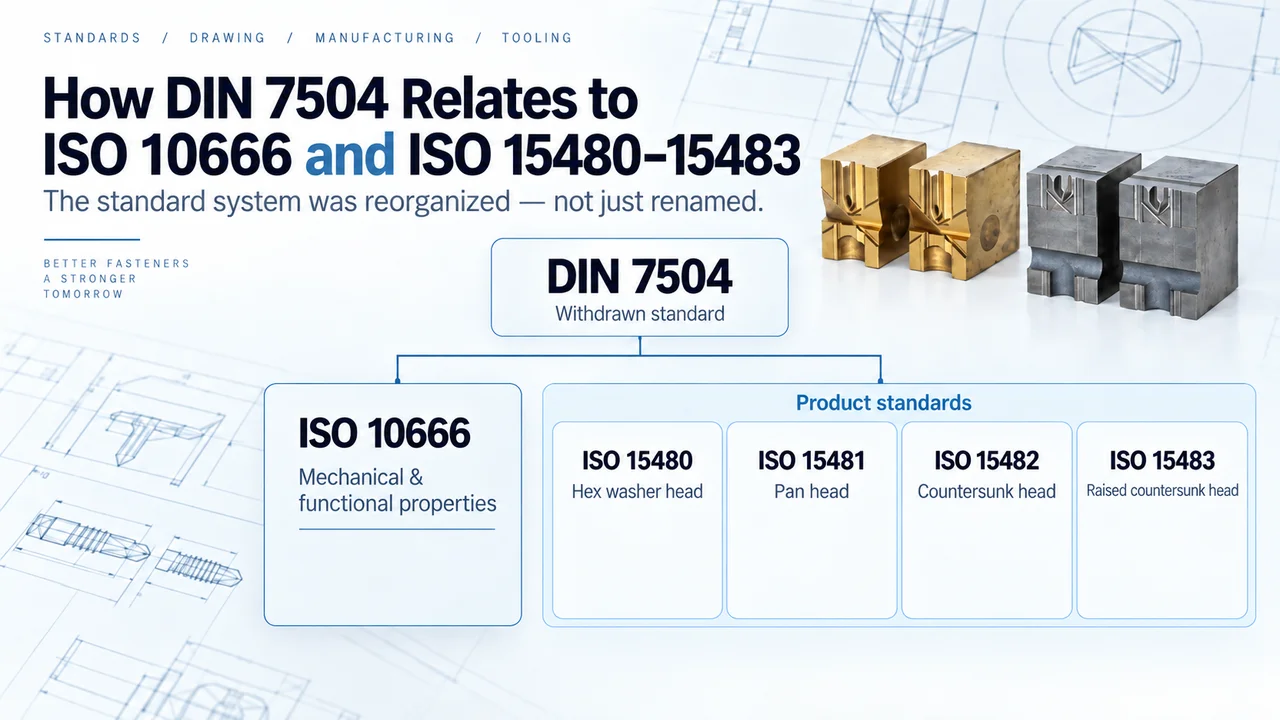
DIN 7504:1995 covered dimensions, requirements and testing for self-drilling screws with tapping screw threads. It was later withdrawn and replaced by several standards, including ISO 10666 for mechanical and functional properties and ISO 15480–15483 for different screw head configurations.
For self-drilling screw manufacturers, this means that changing a drawing reference from DIN 7504 to an ISO number does not automatically mean that the screw, drill point or production tooling must change.
But it also does not mean that everything can be assumed to remain the same.
Before changing production, manufacturers should confirm the actual:
- screw type and head configuration;
- thread size and product dimensions;
- approved drawing and tolerances;
- mechanical and drilling requirements;
- drill point geometry;
- application conditions;
- existing tooling and resulting finished screw.
The practical rule is simple:
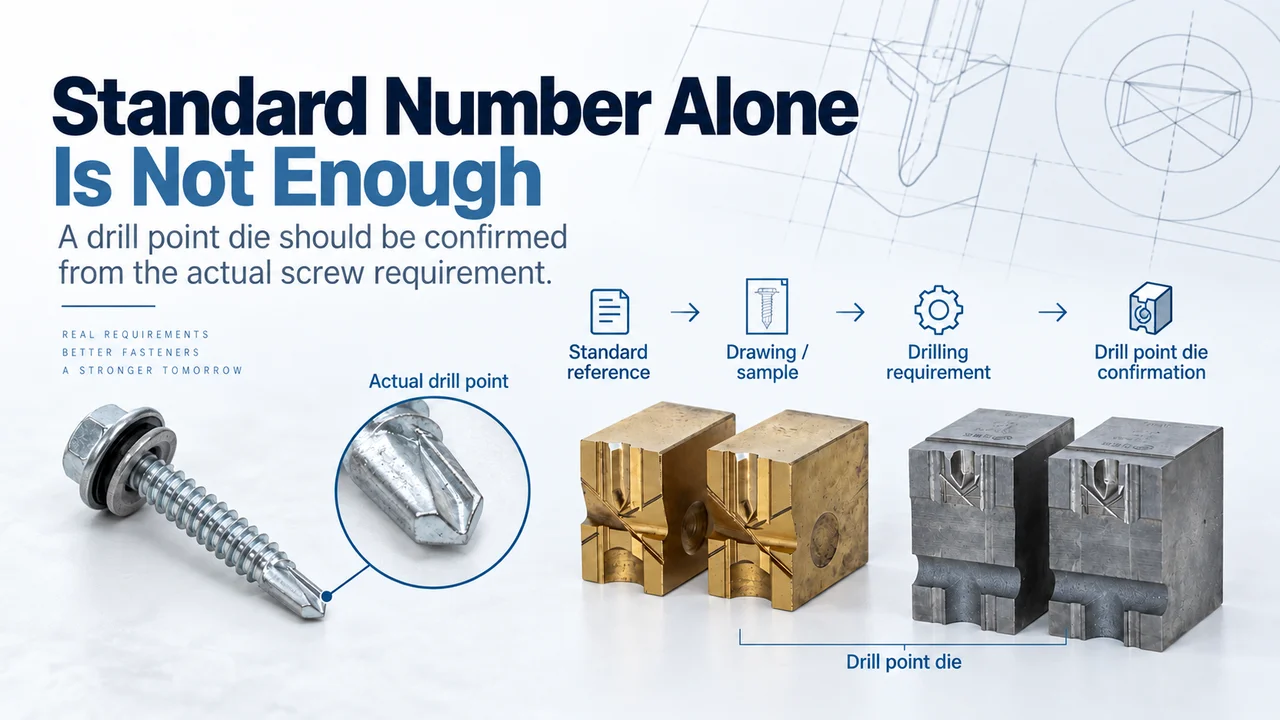
Standard number alone is not enough.
The standard reference is only one part of the information needed to confirm the finished screw and the matching drill point die.
1. What Actually Happened to DIN 7504?
DIN 7504:1995 covered self-drilling screws with tapping screw threads, including dimensions, requirements and testing.
The standard was later withdrawn.
According to DIN Media, DIN 7504:1995 was replaced by:
| Standard | Main Scope |
|---|---|
| ISO 10666 | Mechanical and functional properties of drilling screws |
| ISO 15480 | Hexagon washer head drilling screws |
| ISO 15481 | Cross recessed pan head drilling screws |
| ISO 15482 | Cross recessed countersunk head drilling screws |
| ISO 15483 | Cross recessed raised countersunk head drilling screws |
So the change is better understood as a reorganization of the standard system, rather than DIN 7504 simply receiving a new ISO number.
The product configurations are covered by different ISO product standards, while mechanical and functional properties are addressed separately by ISO 10666.
That distinction matters in production.
When a manufacturer receives an old drawing marked only "DIN 7504," the first step should be to identify the actual screw configuration and drawing requirements — not simply replace the DIN number with one ISO number.
2. Does DIN 7504 Mean the Same Thing as the ISO Standards?
Not exactly.
However, this does not mean that every existing DIN 7504 product must be redesigned.
The important point for manufacturers is to avoid two opposite assumptions.
Assumption 1: "The standard number changed, so all tooling must be replaced."
Not necessarily.
Assumption 2: "DIN and ISO are basically the same, so nothing needs to be checked."
Also not necessarily.
The correct approach is to compare the actual production requirement.
A manufacturer should check the customer's approved drawing, current dimensions, tolerances and performance requirements before deciding whether anything in production needs to change.
This is especially important for older products that have already been produced and approved for many years.
3. Which ISO Standard Applies to the Screw?
The first step is to identify the screw head configuration.
| Screw Type | Relevant ISO Standard |
|---|---|
| Hexagon washer head drilling screw | ISO 15480 |
| Cross recessed pan head drilling screw | ISO 15481 |
| Cross recessed countersunk head drilling screw | ISO 15482 |
| Cross recessed raised countersunk head drilling screw | ISO 15483 |
This is important because DIN 7504 should not be treated as if it simply became ISO 15480.
Different screw configurations now sit under different ISO product standards.
There is another detail worth noting when reviewing current specifications.
ISO 15480 is currently published as ISO 15480:2019, while ISO 15481, ISO 15482 and ISO 15483 remain the 1999 editions and were confirmed as current during their 2024 reviews.
For manufacturers, this is another reason to check the exact standard edition and customer drawing instead of relying only on a familiar standard number.
4. What Should Manufacturers Recheck?
A change from DIN to ISO should trigger a specification review — not an automatic tooling change.
Screw Type
Confirm the actual head configuration and the applicable product standard.
Thread Size
Check the exact thread designation required by the current drawing.
Do not assume that an older DIN designation can always be transferred directly into a current ISO specification without verification.
Product Dimensions
Compare the relevant screw dimensions and tolerances against the customer's approved drawing.
The standard reference does not replace the drawing.
Drawing Revision
This is especially important when the customer has used the same product for years.
The latest ISO reference may be different from the reference shown on the previously approved drawing.
Before changing production, determine which requirement the customer is actually approving.
Mechanical and Functional Requirements
The product standard is only part of the requirement.
ISO 10666 covers mechanical and functional properties of drilling screws with tapping screw threads.
Its key requirements include areas such as surface hardness, core hardness, the ability to drill the required core hole and form the mating thread, and torsional strength.
A screw can look dimensionally correct but still fail its required drilling or mechanical performance.
5. What Does Not Automatically Change When the Standard Number Changes?
A standard-number update does not automatically change the customer's actual application.
For example:
| Item | What Still Needs to Be Confirmed |
|---|---|
| Material being drilled | Actual application |
| Material thickness | Required drilling range |
| Required drilling capacity | Customer requirement |
| Customer-specific drill point geometry | Drawing or approved sample |
| Screw / wire material | Production specification |
| Heat treatment | Applicable product requirement |
| Surface coating | Customer specification |
| Production machine | Actual production setup |
| Drill point die material | Output, screw material and tooling strategy |
| Existing drill point die | Finished screw geometry and test result |
This is why the standard number should never be used as the only basis for a tooling decision.
The real question is:
Does the existing production setup still make the screw required by the current drawing and application?
6. What Does the DIN-to-ISO Change Mean for the Drill Point Die?
This is the most important part from a tooling perspective.
A drill point die forms the drill point geometry of the screw.
ISO 15480–15483, however, are standards for the finished screw product.
They are not drill point die specifications.
Therefore:
Knowing that a screw is "ISO 15480" does not fully define the drill point die.
The standard reference helps identify the general screw family and product configuration.
But a drill point die manufacturer still needs to understand the drill point that must actually be produced.
That normally requires additional information such as:
- Screw diameter
- Drill point geometry
- Required drilling performance
- Drawing
- Approved sample
- Production requirement
This is the key distinction:
- Standard reference = useful information
- Standard reference ≠ complete drill point die specification
Two customers may both describe a screw using the same standard reference while still having different approved drawings, drilling applications or drill point requirements — the same reason two screws with the same 5.5 mm diameter can need different drill points.
That is why tooling should be confirmed against the real product requirement — not selected from the standard number alone.
7. What Information Should Be Provided Before Confirming a Drill Point Die?
If a manufacturer asks only:
"I need a drill point die for ISO 15480."
that is a useful starting point, but it is usually not enough for final die confirmation.
A better request includes the following information.
7.1 Screw Specification
Provide the nominal screw diameter, length, thread specification and head type.
7.2 Standard Reference
For example: DIN 7504, ISO 15480, ISO 15481, ISO 15482 or ISO 15483.
7.3 Drawing
A drawing is especially useful when the product is based on:
- an older DIN specification;
- a customer-specific design;
- modified dimensions or tolerances;
- an already approved product.
7.4 Sample Screw
If the goal is to reproduce an existing drill point, an approved physical sample or clear sample photos can help confirm the geometry.
7.5 Drilling Requirement
The application also matters. For example:
- What material will the screw drill?
- What is the material thickness?
- What drilling performance is required?
7.6 Production Information
Relevant production information, including screw material and forming conditions, can help determine whether the selected die specification and die material are suitable for stable production.
The principle is straightforward:
The more complete the input information, the less the die selection depends on assumptions.
If your product is moving from DIN 7504 to ISO 15480–15483, do not decide whether to replace the die from the standard number alone. Send your drawing, sample and screw specification — we can first review the actual drill point requirement before confirming the drill point die.
Working with these specifications?
Send your screw size, drawing or drilling requirement. Our engineer can help check the matching drill-point die.
8. A Practical Check Flow for Manufacturers
A practical review can follow this sequence:
- Customer specification received
- DIN 7504 or ISO reference?
- Identify the actual screw head type
- Confirm ISO 15480 / 15481 / 15482 / 15483
- Check thread size, dimensions and drawing revision
- Confirm mechanical and drilling requirements
- Confirm the actual drill point geometry and application
- Check whether the existing drill point die is still suitable
- Produce samples
- Dimensional inspection + drilling test
- Approve for production
This sequence separates a documentation change from a real product change.
That helps prevent unnecessary tooling replacement while also reducing the risk of continuing with an old die when the actual screw requirement has changed.
9. A Simple Example
Suppose a manufacturer receives an older customer drawing marked:
DIN 7504 — ST5.5
The first question should not be:
"Which ISO number should we replace DIN 7504 with?"
Instead, check:
- What is the actual head configuration?
- Which drawing revision is currently approved?
- Does the customer require current ISO dimensions or the previously approved product geometry?
- Has the drill point geometry changed?
- What drilling performance is required?
- Does the existing drill point die still produce the required screw?
Only after these questions are answered should the manufacturer decide whether the existing tooling can continue to be used or a different drill point die is required.
A standards update should not automatically create an unnecessary tooling change.
At the same time, an old die should not automatically remain in production if the actual product requirement has changed.
Final Takeaway
The transition from DIN 7504 to ISO 10666 and ISO 15480–15483 is better understood as a reorganization and update of the standards system, not simply a change of name.
For self-drilling screw manufacturers, the most important rule is:
Do not change the screw — or the drill point die — based on the standard number alone.
Confirm the actual screw specification, drawing, drilling requirement and drill point geometry. Then determine whether the existing drill point die still fits the requirement or whether a different die should be used.
Have a DIN 7504 or ISO 15480–15483 drawing? Send us your drawing, sample and screw specification — we can review the actual drill point requirement before confirming the drill point die specification. For the older DIN 7504 dimension tables, see the DIN 7504 spec guide; if die material is the open question, see tungsten carbide vs HSS drill point dies.
Frequently Asked Questions
Is DIN 7504 the same as ISO 15480?
No. DIN 7504 was a broader standard covering self-drilling screws with tapping screw threads, and it was replaced by several standards. ISO 15480 specifically covers hexagon washer head drilling screws, while ISO 15481–15483 cover other head configurations. ISO 10666 separately covers mechanical and functional properties.
Which ISO standard replaces DIN 7504?
There is no single ISO number that replaces every DIN 7504 screw configuration. The relevant product standard depends on the head type: ISO 15480 — hexagon washer head; ISO 15481 — cross recessed pan head; ISO 15482 — cross recessed countersunk head; ISO 15483 — cross recessed raised countersunk head. Mechanical and functional properties are addressed through ISO 10666.
Does changing from DIN 7504 to ISO mean I need a new drill point die?
Not automatically. If the existing die still produces the geometry required by the current approved drawing and the finished screw meets the required performance, a standard-number change alone does not mean the die must be replaced. The actual product requirement should be checked first.
Can I order a drill point die using only “ISO 15480”?
It is a useful starting point, but normally not enough for final tooling confirmation. The screw diameter, drill point geometry, drawing or sample, drilling requirement and production conditions should also be considered.
What if my customer still uses a DIN 7504 drawing?
Do not automatically convert it. First confirm the head type, screw dimensions, approved drawing and actual performance requirement. Then compare those requirements with the relevant current ISO standard before deciding whether the product or tooling needs to change.
Does ISO specify whether I should use an HSS or tungsten carbide drill point die?
No. ISO 15480–15483 define requirements for the finished screw, not the material of the production die. The choice between HSS and tungsten carbide is a tooling decision based on factors such as the screw material, production volume, stability requirement, expected die life and production conditions.
WHEN YOU ARE READY
Get a Die Recommendation for Your Screw
Share what you already have. Our engineering team can review the information and help identify a suitable drill-point die specification before quotation.